Categories
art book camden benares discordianism jfk john f. carr writings

Camden Benares and John F. Carr’s A LEGACY OF SEX, DEATH AND CHARISMA

“To follow is the third version of ‘A Legacy of Sex, Death and Charisma’ written by myself and Camden Benares around 1988. The first version was written by Camden and was significantly different, featuring a Marilyn Monroe film festival. Brother Ball was the main protagonist and it featured Fitzgerald Baker in a much different situation. The original story was written in the late Seventies before we had completed the first book of our opus, The Crying Clown Celebration.

We had a much better understanding of our characters after completing The Book of Phillip and our intention was to sell this short story to one of the SF magazines and use it to promote the novel. Unfortunately, it never sold. So there it is 25 years later. I still believe it’s one of the best things we ever wrote.”
John F. Carr,
Boalsburg, Pennsylvania,
Sept. 2015

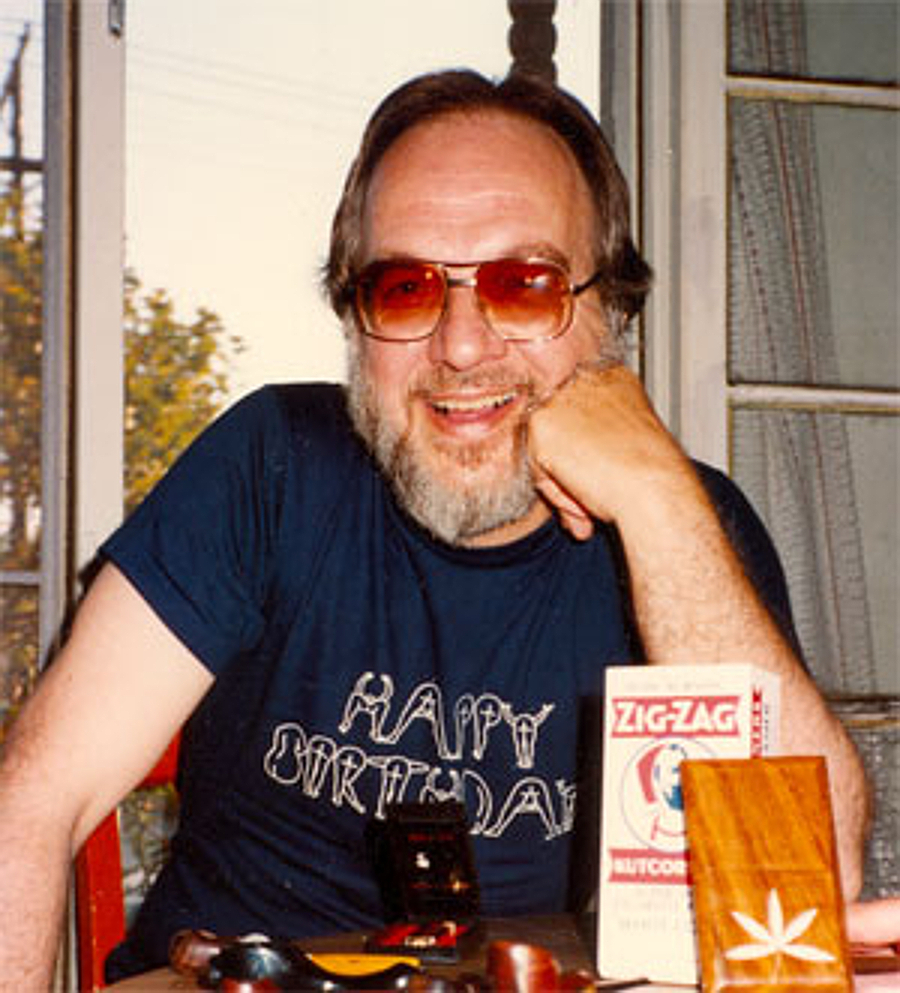
Smiling Early Discordians, Camden Benares and John F. Carr.


A LEGACY OF SEX, DEATH AND CHARISMA

Camden Benares & John F. Carr
Copyright 2010 by John F. Carr

Fitzgerald Baker may well have been conceived in an act of erotic terrorism. That was what his mother had told him and it can be verified that Felix Pendragon initiated her into the League of Erotic Terrorists. However, she was also known to sacrifice truth for entertainment in most of what she said. Her story of spitting the ejaculation into a hypodermic and using the needle to perforate her hymen to accomplish a virgin birth was entirely fictional. But Fitz hadn’t come to a lifestyle crisis counselor because his mother was an artist at the whiff riff.

He was thirty-eight years old and had already come to terms with his mother’s reality according to the genealogy chart he handed me:

John Fitzgerald Kennedy
1917 to 1963
Assassinated
Norma Jean Baker
alias N.J. Mortenson
alias Marilyn Monroe
1926 to 1962
probable suicide
 
Gene Fitzgerald Baker
Born between 1958 & 1961
Assassinated in 2002
(see note #1)
 
Zelda Harrington
birth date unknown
Assassinated in 2002
(see note #2)
 
Zach Fitzgerald Baker
2003 to 2052
 
Mary Gulik
2033 (?) —
(see notes #3 & #4)
 
Fitzgerald Felix Baker
2050 —

Notes:

  1. The allegation that Gene F. Baker’s parents were J. F. Kennedy and Marilyn Monroe cannot be proved or disproved.
     
  2. There is no verifiable background data on Zelda Harrington. Mary Gulik has said that the name was an alias for erotic terrorist Robin Jefferson. Zelda Harrington was pregnant when she disappeared immediately after her husband’s death.
     
  3. The woman who took the name Mary Gulik was approximately two years old when left at a Daughters of Demeter lodge.
     
  4. Mary Gulik is an unreliable source of information. She once said, “Relating the mundane truth is a failure of the imagination.”


Baker had made the appointment through my answering service. His actual words as recorded on the thread spool were, “My name is Fitzgerald Baker. I want an appointment with Counselor Wendell as soon as possible. He was recommended to me by Clyde Burbank, my partner in the architectural firm of Burbank and Baker. Prior to my appointment, I wish for Counselor Wendell to see the head thread, The Crying Clown Rites. Any expenses in connection with the viewing may be charged to my account.”

As I was waiting for him to arrive, sitting at my console watching the movements of a free fall mime troupe on the holly, the control panel emitted a low chime and showed the flashing light that indicated a visitor had entered the foyer. I punched two buttons on the keyboard. The mime troupe was instantly replaced by the three-dimensional image of a tall, youthful-looking man wearing a sheen suit of metallic blue and gold that fit smoothly over his well-muscled frame.

As he came closer, I looked for signs of strain on the face framed by shingle-cut, shoulder length, chestnut brown hair. When his face was nearer the camera, red fatigue lines showed around the blue irises of his eyes. Beneath the straight nose there was a full moustache that partially obscured the set line of his mouth. The movements he made as he reached into his pocket showed that he was under a strain and putting effort into controlling it.

His hand emerged from his pocket with a key card which he held against the scanner. I looked at it on the monitor and read:

Fitzgerald Felix Baker
ICID: 0-915904-24-1

I pressed the control that opened the first set of doors. Fitz went through them, waited for them to close and then stepped through the second door when I punched the release. His first words on entering my office were: “Clyde Burbank recommends you highly. Your success in handling his success crisis was very effective. He thinks you can help me with my problems.”

“Sit down and tell me about them.”

He handed me his genealogy chart and asked, “Have you seen The Crying Clown Rites?”

“Yes. I have a copy here which we can view on the holly if that is desirable.”

“No. I don’t want to see it again. That’s why I asked you to see it before this appointment. Take a look at the chart I gave you and you’ll know almost as much about my origins as I do. Then we’ll get into my present problems.”

I scanned the chart, then read it quickly, finding no connection at least, no apparent connection between it and the thread that detailed the rites of passage into manhood within an obscure, macho enclave.

When I looked up, Fitz said, “As you’ve just read, my background connects me to the old Kennedy clan. That chart doesn’t show the aunts, uncles and cousins whose lives ended by assassination, suicide or disappearance. I don’t know whether I’m going to live long enough to develop a satisfactory lifestyle or not.”

“Do you think that someone is trying to kill you?”

“I don’t know. Lately, I’ve had the feeling several times that I was being monitored.”

“Have you considered hiring a security service?”

“Yes, but I don’t want to do that if there are any good alternatives. I would hate to be imprisoned by my own ancestry.”

“Have there been attempts on your life in the past? You could be being monitored for some other reason than assassination.”

“There haven’t been any attempts in the past several years, but before then there were two definite attempts and some close calls in near accidents that could have been planned by an unknown group or individual. That may sound paranoid to you. Let me show you that if it is paranoia, it has a solid foundation.”

Fitz pulled open the presfast at the top of his suit and showed me a scar that looked like a laser gun crease, dark, puckered skin next to a gold medallion on a chain. Then he said, “That scar was made by an assassin at a political rally on the University of California Berkeley campus. She escaped in the crowd and was never captured or identified. I gave up my political science major, transferred to UCLA and became an architect.”

Fitz seemed lost in memories for a minute. I asked, “What’s the significance of that talisman around your neck?”

He pulled the metal and chain over his head and handed it to me. It looked and felt like gold. The lines of the design were worn but recognizable as a boat. Sunken letters on the back spelled out Kennedy. Fitz said, “My mother told me that it is a replica of the boat my great-grandfather commanded during Hitler’s war. She said that he gave it to Marilyn Monroe and it’s been in our branch of the family ever since.”

“Let’s get back to your present problems and why you wanted me to see The Crying Clown Rites.”

“I wanted you to know a little about my background so you can understand how seriously that head thread affected me. In the thrill kill scene, I saw the hunters as all the assassins lurking around my family tree and I identified with the victim. Maybe I should have left then, but I stayed. When they got to the actual initiation rites and one initiate said, ‘I don’t have to go through this: I can die,’ and then tries to commit suicide by holding his breath. That’s when I ran out of the theater, vomited in the street, again in the vault station lav and for a third time when I got home.”

“What did you do then?”

“I took an Oblivion Blue. When I woke up, I made the appointment with you.”

“Do you have any problems in your business life?”

“Only an increasing feeling of encroaching boredom across the entire spectrum of architecture.”

“Sexual relations?”

“Nothing enduring. I find casual encounters adequate to meet my present needs.”

“What is your domestic situation?”

“I live alone.”

“Would you describe yourself as lonely?”

“Not exactly. There are people and activities in my life, but not enough meaning, not enough significance. I’m tired of transient personalities, throwaway relationships and plug-in lifestyles. By objective standards I’m successful, but I’m almost middle aged and bored with the future I see for me. The Crying Clown Rites was the input that caused an overload. Not only did I feel that I had missed something, failed to complete my personal rites of personhood, but I found myself simultaneously worried about assassination and suicide. I don’t know if I’m going to live long enough to come to terms with my own death wish.”

Fitz was showing signs of agitation which meant to me that I should bring this session to a close. I asked, “Do you have any religious or ethical prohibitions concerning suicide?”

“No. I’ve never been captured by any ideology that emphasized negatives and prohibitions.”

“Then the next step in resolving your crisis is to discover whether you wish to live or die. I’ll need a diagnostic analysis and your approval of the procedures.”

“I don’t give a damn about the procedures. I’m very interested in the answer to that question. What do I do and when do we start?”

“Take off your clothes and step into the diagnostic analyzer.”

Fitz shed his sheen suit and entered the white cubical. I keyed in the program for maximum information. In a few minutes I would have a complete medical file on Fitzgerald Baker.

When Fitz emerged dressed from the cleanser, I said, “It will take about three days to make preparations. Can you be here at eleven hundred on Friday?”

Fitz confirmed the appointment and left. I fed the thread I’d made of the session into the computer for stress analysis, punched in a request for full information on John Fitzgerald Kennedy and began to plan the next session with Fitz.

At the end of my working day, I sat down at the console to clear my head for the evening’s activities. I lit the candle in the custom holder, watched it as it flickered. The sensor in the rim of the holder used the heat as energy to push the candle higher each time the flame dipped below the rim. I punched the key for the candle exercise thread and concentrated on the candle flame as my own voice at random intervals asked me, “Where are you?”

When I reached the right space, I left the office, and Fitz’s problems with it, until the next day.


All my preparations were complete when Fitz arrived promptly at eleven hundred on Friday. I ushered him into the green room and asked, “Have you ever experienced pharmodrama?”

“No. My only knowledge of it comes from the holly.”

“I want to explain a little about it so that you will focus on the experience instead of on the techniques used to produce it. Basically, pharmodrama uses pharmaceuticals and technology in combination to create a drama in which you will be the central character. The drug mixture that I’ll give you is adjusted for your chemistry. The drama will take place while we’re sitting in these recliners with the sensor skullcaps on.

Fitz interrupted to ask, “Will we both be having the same experience?”

“Not exactly. You are going to be the star; I’m going to see the same scenes but I will tuned in to your reactions to the experience.”

“Is this going to tell you whether I wish to live or die?”

“It’s going to tell both of us.”

“Good, what else do I need to know before we start?”

“When the drugs begin taking effect, you will become aware of everything that you think of as you slipping away and may be somewhat surprised to discover that you still exist when all that represents you to you is gone. As soon as your reactions to that state stabilize, an identity thread will be fed into your brain via the skull cap to create the temporary persona that you will be for the drama.

“I’ll be outside of your own awareness but tuned into everything that, you experience, ready to handle any problems if there are any.”

Fitz said, “I’m ready.” He sat down in the recliner. I injected the drug mixture into him, adjusted the controls so that only I could read the monitor output and waited for the temporary chemical dissolution of the facade that Fitz presented to the world.

When the readout confirmed that Fitz was ready, I fed the identity thread into his skullcap. As soon as positive pickup registered, I took the maximum dose of Empathy Plus for someone with my metabolism and empathy quotient and waited.

As the Empathy Plus coursed through my blood stream, I could feel my own personality receding, enabling me to identify with the star of the drama I was recreating, a drama based on some of the known facts in an historical event. I put on my skullcap and verified that I could detect and empathize with the thoughts and feelings of my client, who now believed that his name is John Fitzgerald Kennedy and that he is the thirty-fifth president of the United States.

The drama began with the voice of a reporter coming directly into our brains, a voice with most of the regional accent lost through announcer’s training but the rhythm of the speech was definitely American Southwest and the hint of a Texas drawl hovered over the words like a hummingbird checking out a flowering plant. At some deep level I knew it was the voice of an actor hired by me to record the message he was delivering, but within the pharmodrama framework, I was hearing it as Fitz heard it as an announcer’s voice coming out of the open-topped vehicle’s radio, saying, “For those of you who just tuned in, November 22, 1963 is a pleasant day here in Dallas, just right for a presidential motorcade. I’m here at Dealey Plaza and according to the schedule I was given, President Kennedy should be coming into sight any moment now.”

The laser beam scanner transferred my client’s thoughts via computer into my skullcap as input, thoughts that became mine as my own personality submerged and I became the pseudo John Fitzgerald Kennedy:

I was waving to the crowds, hearing them cheering, hoping that the presence of Governor John Connally and his wife in the car would help convince skeptics that I had patched up the differences between conservative and liberal factions of the Texas Democratic Party.

With the facsimile of excitement in his voice, the announcer said, “Here comes the lead motorcycles turning onto Elm Street. There is the presidential limousine now, a blue Lincoln coming this way. The President is waving to the crowds who seem very excited. The President’s wife is sitting beside him. Just in front of them, in the seat behind the driver are Texas Governor Connally and his wife. I’ve never seen the people of Dallas give anyone a more enthusiastic reception.”

Mrs. Connally turned toward me from the forward seat and smilingly said, “You can’t say the people of Dallas don’t love you, Mr. President.” As I started to smile at her in reply, there was a loud noise. I seemed to be riding the crest of a shockwave.

What’s happening? I can’t think straight. Did I have too much to drink? Never liked heavy drinking parties anyway. Remember Charley at Harvard. Always lushing it up, especially after midterms. I remember his favorite toast:

Drink it up!
Drink it up!
Drink it up!
If you die young,
What’s the diff?
The coeds will say,
As they lay you away,
“That’s a good-looking stiff.”

The shockwave hit me again. It’s that Japanese destroyer. It’s run into our starboard side. The wheel is being torn out of my grasp. My back just hit the rear of the cockpit. Somebody is saying something, but I can’t understand it. It’s Johnston saying to someone who’s moaning, “Aw, shut up. You can’t die. Only the good die young.”

That’s right, Johnston, you tell them. I can’t die now. I’m still in my twenties. Only the good die young. Like my brother Joe. Joe was good. His death made me resolve to do better. Wait a minute. Joe died in 1944 and I was on Olasana Island with Johnston in 1943. What’s going on? Time and space are closing in together. There’s blood all over Jackie’s pink suit and I hear that voice again.

The announcer’s voice continued, “Those loud noises were shots. I can’t tell whether the President has been hit or not. He’s leaning forward and his wife is bending over him as the car continues down the hill. I think that Governor Connally has been hit. It looks like he was driven downward to the floor of the car. Did you hear that noise? That was another shot.”

Last effort to make sense of this. Got to clear my head. Someone is yelling something about Parkland Hospital. I can take it all in now, all of it. That’s blood on Jackie’s suit. The crowd seems to be running in different directions, screaming, yelling and pointing. What are those People doing? They’re picking up bits of bloody bone. One has a handkerchief. It’s like with Dillinger. They’re souvenir hunters. Where’s that bone from? Is it Connally’s? He’s slumped down and looks bad. But the hair’s wrong. John’s hair doesn’t have that much color. Could it be colored by the blood? Could blood make it look that color of reddish brown? The car is going faster now and I can’t see many details. I’ve got to make sense out of all of this. The wind noise is taking all, the sounds away. I can’t understand what is being said. I can’t feel the air hitting me in the face anymore. Everything has a pink tinge to it. Am I looking at Jackie’s suit or is that blood in my eye? I can feel the pain building into another wave. It’s headed my way. Got to figure out some way to stop it. Feels like it’s going to be as bad as that pain in my back. Oh God, I understand it now, but I’m not ready. I’m only forty-six and I’m dying young.”


With learned mental effort I wrenched my own personality free from the consciousness of the pseudo John Fitzgerald Kennedy. Rapidly I phased out all the input to Fitz Baker and replaced the Dallas assassination reconstruction thread with the personality recovery program that would leave the, memory of the pharmodrama intact. While the monitor gave me visual indications that Fitz was re-becoming himself, I paid attention to my breathing, calming the intense emotional experience with concentration on the repetition of the inhalation crest and the exhalation trough.

Once the disconnection procedure was complete, Fitz, still seated in the recliner, looked toward me and said, “I want to live. I really want to live, don’t I?”

“There is no doubt in my mind. Is there any in yours?”

“No. I was him but the feelings about premature death were all mine. Do you think he felt as I did? Is it possible that our internal experience was the same?”

“It may have been, but there is no known reliable method of chronicling the unrecorded thoughts of the dead. Some of the religious groups are exploring that territory. Of course, very little of their data can be verified because of its subjective nature. Is knowing what he thought as he was dying important to you?”

“I don’t know yet. I haven’t quite recovered from the identification with him in the pharmodrama. I think I’ll go to Arlington, where he’s buried, this year and say a final goodbye to him on the anniversary of his death. Then I’ll be able to let him rest in peace, maybe we both will.”

Fitz resting in peace had an ominous connotation, reminding me of his fears of being monitored for the purpose of assassination. I said, “You might have more peace of mind if you called Max Security and have them check whether or not you’ve been monitored lately and if you have, by whom and for what purpose.”

“Is that a professional recommendation?”

“I’d recommend the same procedure to a friend.”

“Okay, I’ll do it. What else?”

“I’d like to see you again on Monday. By that time you should have the Max Security report. Why don’t we meet for brunch at the Egg Keg around 10:30? You know where it is?”

“I walked past it on my way here from the vault station. I’ll see you on Monday.”

Fitz got up from the recliner and left. That was a reassuring sign. An intense pharmodrama experience like he had just undergone tends to immobilize some of the crisis prone for up to forty-eight hours.


On Monday, Fitz was in the anteroom of the Egg Keg when I arrived. I turned on my ever present pocket recorder before he said his first words to me, which were, “I got the Max Security report: I was being monitored about ten days ago.”

“By whom?”

“The government. According to the report, I’m one of the architects being considered for a government project. That is a waste of time and effort on their part. I would never attempt to do creative work for a bureaucracy. It would drive me bureau crazy.”

We went into the restaurant, showed our key cards to the scanner, punched out our orders on the menu terminals and, in a few minutes were eating our omelets, mine with truffles and Fitz’s with mushrooms, and drinking light draft beer from chilled crystal mugs. When we were finished, I asked Fitz if he were willing to vault somewhere else for coffee. (A small minority of humans get nauseous from teleporting on a full stomach. Fitz was evidently not one of them.)

“Do you have a particular place you prefer?” asked Fitz.

“The coffee bar in the pyramound at Calm Springs, if that’s acceptable to you.”

“Of course it’s all right with me. Clyde was certain that you would make yourself familiar with my work as part of the counseling, but then my partner is right about most things. I imagine that we’ll talk about architecture over coffee. I’m ready.”

We left the Egg Keg and began walking toward the vault station, two affluent members of a mobile society where only a minority lived at the misery level. The combination of structural glass and spring sunlight along our route occasionally flashed our reflections back at us two men matching their walking pace to each other, Fitz a few centimeters taller than me, his prominent Adam’s apple and depilated chin contrasting with my full, short, black beard, his copper-colored sheen suit harmonizing with my rust jump suit. Both of our minds were on the same subject. That was confirmed when Fitz asked, “Did my partner tell you why he decided to become an architect.”

“No. He mentioned that his family encouraged him.”

“It was something that his grandfather told him. Clyde asked his grandfather why he had moved to California. The old man told him, ‘I was born in New York. My parents were born in New York. All four of my grandparents were born in New York. When my son was born, also in New York, I couldn’t wait for him to get old enough to appreciate his cultural heritage. By the time he was, we were living in a new building on the other side of the city. I took him back to the old neighborhood to give him an appreciation of the past. All of the buildings were gone, replaced by newer ones. Not a single place where any member of our family ever lived before was still standing. What heritage was there to share? None. I talked it over with your grandmother and your father and we decided to come to California. After we’d been here for a few years, I saw the same thing happening here, new buildings for old. By this time your father had frequently demonstrated a talent for taking things apart, so I encouraged him to go into the demolition business, but you shouldn’t go into your father’s business, Clyde. You are creative. You should create buildings that will last long enough for your grandchildren to see them.’ So Clyde Burbank became an architect.”

“You remember that story well. Can you tell me what made it important to you?”

We walked about another thirty meters before Fitz ended his frown of concentration and said, “I never met either of my grandfathers and I never got that kind of advice. I became an architect by a different path but with the same kind of spirit that Clyde’s grandfather inspired in him. That’s what the study of architecture created in me. That’s probably what Clyde recognized in my designs that caused him to ask me to become his partner.”

The vault station was just ahead of us. As we entered an assorted party of six, all wearing the faddish after-midnight makeup of Chinese red, emerged, talking about a festival that they had evidently attended in Hong Kong. They headed for the cleansers as Fitz and I went to the terminals, thumb pressed our key cards to the scanners, punched in our destination, and went to our respective booths.

Inside the darkened cubicle, I felt the sensations that teleportation always induces in me: the bubbling of my blood through my veins and arteries as if champagne were circulating in my body, the tingling of my skin as my brain recorded the feeling of thousands of small brushes gently stimulating the surface that connected me to the rest of the world, the lightless flash as I was transported via the energy force lines of the Earth to the foothills of the San Bernardino mountains.

I emerged from a similar cubical into the Calm Springs vault station, which differed from every other vault station only in its signs. Automatically, although if I had thought about it I would have realized that I hadn’t changed time zones, I checked my watch against the clock showing local time.

Fitz, having, of course, arrived at the same time, saw me look at my watch and said, “Local time is 11:48.” As far as I could tell he hadn’t glanced at the clock and he wasn’t wearing a visible watch. I asked, “What told you the correct time?”

“It’s one of my tricks. I always know what time it is wherever I am.”

“How did you learn that?”

“I’ve always had that ability.”

“Can you teach it to me?”

“I don’t know how to teach it to anyone, but if I ever learn how it’s done, I’ll tell you.”

As we left the vault station I saw the pyramound about two kilometers away. I had seen it before but saw it with new eyes now that I was standing beside the man who designed it. The hemispherical top was the mound that collected the maximum solar energy for utilization in the modules below which were assembled in the form of an inverted pyramid. Each outside corner was supported by a tubular structure that housed both a lift and a baffled gravity drop which could be used for humans and equipment.

The structure was visually appealing and blended harmoniously with the nearby foothills and mountains. With unspoken agreement Fitz and I boarded the tram that ran from the vault station to the building. Moving closer to the pyramound changed the visual, but not the mental, perspective from which I viewed it.

Fitz was looking off into the distance, perhaps at the tops of the mountains. I got his attention by saying, “I compliment you on your achievement.”

“Thank you. It’s one of my better efforts.”

“It looks like it was specifically designed for this spot, was it?”

“Yes, this was where the dowser found the water, using a bent coat hanger as an indicator.”

As we neared the first of the lift/drop tubes, I asked Fitz if he had invented the concept. He said, “Oh, no. The design of powered lifts and gravity drops have both been around for a while. I just modified them for the pyramound. When the techies were responsible for most architectural design, what John Brunner called ‘shitabrick phase architecture,’ there were no gravity drops, which meant that a power failure created instant disaster for the people but no damage to the building it was the same kind of ignorance in action that produced the neutron bomb and a history of human warfare.”

Proceeding to the terrace, Fitz and I continued our discussion. While getting coffee from the automatic dispenser, Fitz asked, “Can you name one architect from the last century who has an admired work still standing now?”

“Wright.”

“Right. Can you name one of his works that you’ve seen?”

“The Swedenborg glass chapel at Portuguese Bend.”

“You are hereby awarded two points, would you like to try for four?”

“No, I’d rather concede that most of twentieth century architecture was uninspired and not well adapted to human needs and values.”

We took our coffee cups to a nearby table with a view of the mountains. I mentally reviewed what Fitz had said previously about architecture before speaking again.

“You mentioned at our first meeting that you were bored with architecture. Would you like to expand on that thought?”

“I’ve established myself as an architect. I’m not plugged into any energy drains that require me to work and I’ve accomplished the architectural goals that I set for myself. This building, with its replaceable modules, will probably survive longer than I will. What architect could ask for more in a world where change seems to be the major constant? I could. I wanted to create a building that would be an artistic tribute to those changes, an edifice to edify humanity, a temple of humanity. Do you know the project that I’m telling about?”

“Yes, your design of the Pantheon of Prophets. It’s a great achievement.”

“I’ve completed it. It’s opening next week and I’m so bored with the entire project that I’ve been looking for some excuse to avoid attending the dedication. Do you know what most architects are working on now? Huburbs. That’s like reinventing the wheel. Of course each one is different, but every one has the hub center which usually is a vault station. Every one has a variety of structures in the spokes and rim. Some of them make interesting or practical use of the space between the spokes. The only major question of design is what style: Egyptian, Mesopotamian, Persian, Greek, Roman, medieval, renaissance, academic, baroque, functionalism, technic or some combination of any number. If I had to devote the rest of my life to that kind of work I would feel empty. I don’t intend to suffer that kind of professional deformation.”

“I understand what you mean.”

“Perhaps you do vicariously, but what would you do if you were experiencing a lifestyle crisis? Go to another lifestyle crisis counselor or handle it yourself? Do counselors have the same kind of crises as other people?”

“Some of them do, but the two main occupational hazards are suicide and insanity, the traditional refuges from inescapable reality.”

Fitz finished his coffee in a final swallow before asking, “If you felt near an overload now, what would you do?”

“Meditate, exercise or vault to a place where I could change my head around.”

“Let’s go to one of those places, one with a minimum of architecture.”

We took the tram back to the station, vaulted to Pasadena and walked to the Western Zen Gardens, where there were cacti, rocks and sand enclosed within a perimeter of trees that blocked all buildings from view. A carved wooden plaque, beside the gate read:

The sound of Zen is the sound of rain.
The taste of Zen is the taste of tea.
The feel of Zen is the feel of the wind.
The smell of Zen is the smell of the sea.

Fitz and I walked quietly through the garden until we came to the arced mound where an assorted group of people were sitting cross-legged on the ridge, some of them meditating, others watching the Zen Shaman as he raked gently flowing curves in the sand. When the Shaman finished, he turned to the seated gathering and said, “I feel that it is question and answer time. Any of you may ask any question. I will answer it to my own satisfaction which may not be the satisfactory answer for you. Bear in mind that I speak for no one but myself and that I am not here to debate philosophical or theological points. Who has a question?”

A serious looking young man, halfway between puberty and full physical growth, asked, “How can I atone for original sin?”

The Shaman replied, “There is no original sin and therefore no atonement is required. All of us are born without sin, living Buddha’s full of Zen.”

A balding man in expensive clothes asked, “Why does the quality of life seem to decrease as I grow older?”

“Welcome to the here and now,” said the Shaman. “Everything that you have experienced has been necessary to get you to where you now are. If you think that you have ever been in a better place, stop looking backwards and face the direction in which you are going.”

The balding man responded with, “What will you do if someone asks you a question you can’t answer?”

With no show of surprise, the Zen Shaman answered, “In Zen Buddhism there is a device known as a koan, which is a paradox or seemingly unanswerable question, used for meditation. If I am asked such a question, I shall use it as a koan.”

An attractive brown-skinned woman of less than thirty years asked, “How can I resolve problems of morality?”

“Any code of morality is formed by abstracting from nature and creating a guide to behavior. Such guides are useful to many people, but they become unpleasant tools if they are used to attempt to control the behavior of others. Your morals are for you alone. If they require the belief of others, they will frequently conflict with the reality you experience. Never let your sense of morals prevent, you from doing what you perceive as right.”

A robed figure of indeterminate age and sex asked, “What makes you think you have all the answers?”

Looking toward the speaker, the Shaman replied, “I don’t have all the answers because there are many more answers than questions. For instance, the question, ‘Where have you been?’ has an incredible variety of possible answers from any one person. The answer to the query, ‘What am I seeking?’ differs from individual to individual. The person who has an answer for every question doesn’t have to know all the answers.”

A middle aged woman asked, “What is Zen and what is its purpose?”

The Shaman replied, “Zen is the radical approach to clarifying and liberating consciousness, a way to help create the experience of Buddha that state of enlightenment in which you and your actions are one.”

Fitz got the Shaman’s attention and asked, “Do you believe in any god?”

“I believe in a cosmic consciousness that could be defined as a deity, but belief in a god is not necessarily essential to becoming one with your experience unless you want a personal relationship with a god.”

A restless prepube with shoulder-length hair as black as mine asked, “What is the secret of Zen?”

“Zen has no secrets,” said the Shaman. “Are there-any other questions?”

No one responded, The Shaman, inclined his head toward the gathering, said, “You are the Buddha,” picked up his rake and walked down the garden path. Some of the people remained, but others began to leave, Fitz and I, by unspoken agreement, among them.

Just before we reached the gate posts from which no gate had ever hung, Fitz stopped to read the haiku-type poem there:

With nothing to do,
Liberation’s journey begins
With nowhere to go.

I waited patiently while Fitz pondered that paradox for several minutes. When he had stood there longer than necessary to commit the three lines to memory, he turned to me and said, “I’m going to attend the dedication ceremony for the Pantheon of Prophets. Then I’m going to stop designing buildings, maybe just for a while, maybe for the rest of my life. I’ve concentrated on my profession and neglected my own spiritual development in the process. It’s time for me to take a sabbatical.”

“Call me if you need additional counseling, or even if you don’t. I’d like to know where your journey takes you.”

Fitz agreed to do so. Then we came to the vault station and went our separate ways, for a while.
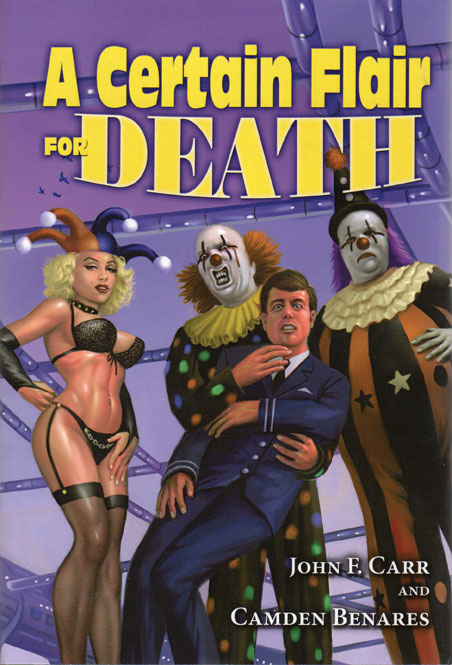

A Certain Flair For Death
by John F. Carr
and Camden Benares.
Available on Amazon Kindle and in Hardcover.
Categories
barbara reid book discordianism interview jfk jim garrison kerry thornley lee harvey oswald letters photo warren commission

Barbara Reid: Voodoo Practitioner, Discordian Society Member and Dealey Plaza Irregular (Part 00002)

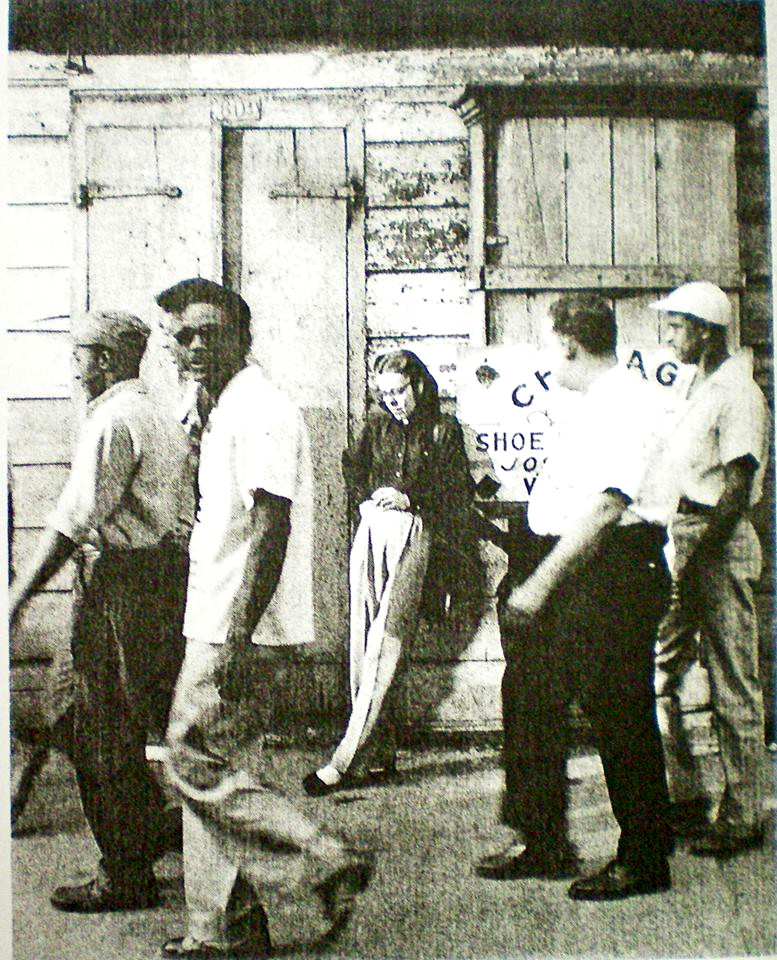
Barbara Reid taken in the
French Quarter street scene
during the early 1960s.
Read Part 1 of this series here.

Barbara Reid was not only a voodoo practitioner, beret wearing bohemian, Early Discordian Society member and traditional jazz buff, but she was also a key witness in Jim Garrison’s investigation.

As Discordian history instructs, Reid claimed that she saw Kerry Thornley and Lee Harvey Oswald together in New Orleans in September 1963, although Thornley denied this accusation, insisting that the last time he’d been in contact with Oswald was at El Toro Marine Base in 1959.

According to Jim Garrison in On The Trail of the Assassins (Amazon):

“From his own admission, as well as from the statements of Barbara Reid and a number of others, we learned that Thornley had been in New Orleans in 1963, finally leaving the city only a few days after Kennedy’s murder. Reid, a long-time French Quarter resident who had known both Thornley and Oswald, described seeing them together on several occasions. One of them was in early September 1963 at the Bourbon House, a combination bar and restaurant in the French Quarter. Thornley, who usually wore his hair extremely long, had just returned from a trip out of town. This time he was wearing his hair unusually short and closely cropped, as Oswald invariably did. Reid recalled having said to them, “Who are you guys supposed to be? The Gold Dust Twins?

“We were eager to talk to Kerry Thornley, but he was not an easy man to locate. It took us a lot of legwork and more than a year to do it. We had investigators going to every place in the French Quarter until we learned what had been his main hangout—Ryder’s Coffee House. Except for occasional visits to the Bourbon House on Royal and Bourbon Streets, Thornley seldom went anywhere else.” 00001

Inside the span of two mere paragraphs, Garrison was able to stuff a staggering amount of misinformation. His claim that Barbara Reid knew Oswald has no factual basis, as Reid’s only encounter with Oswald (or someone she thought was Oswald) occurred during her supposed sighting of Oswald and Thornley at the Bourbon House in September 1963.

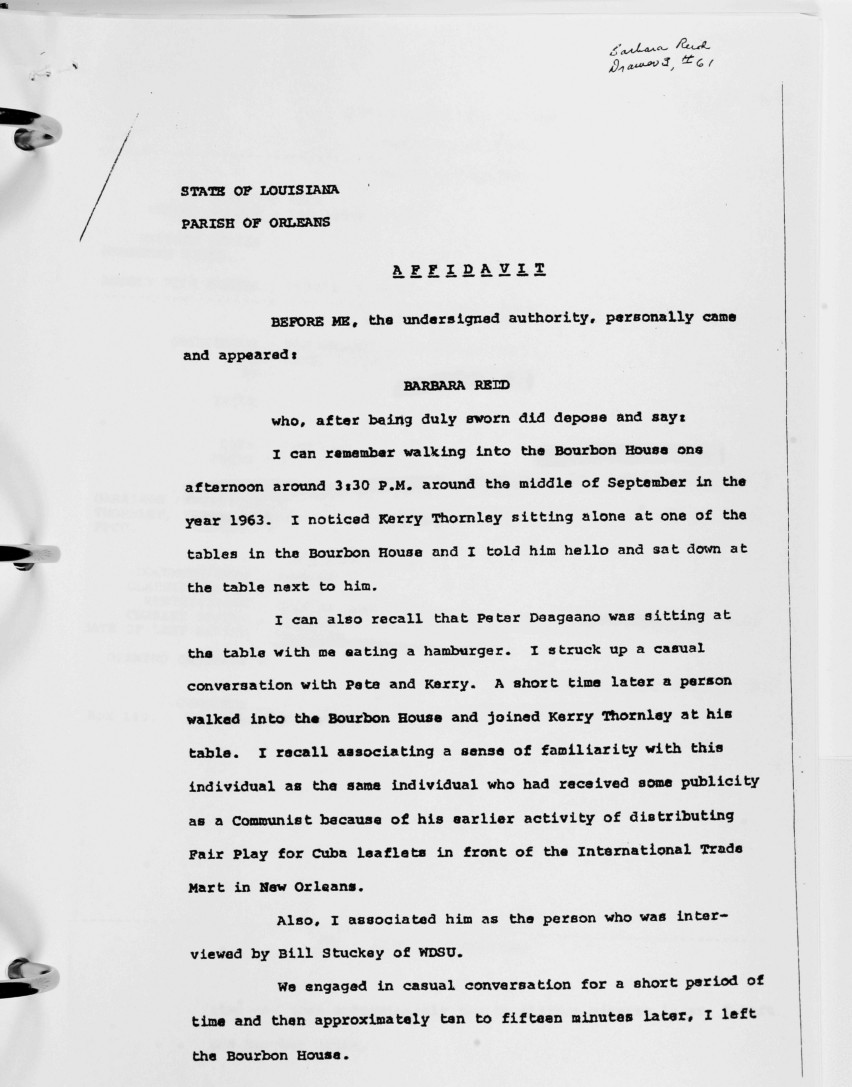
How Garrison came up with the notion that Reid actually knew Oswald is another head-scratcher. Reid never claimed that she knew Oswald. In her 1968 affidavit, Reid recalled “associating a sense of familiarity with this individual who had received some publicity as a Communist because of his earlier activity of distributing Fair Play for Cuba leaflets in front of the International Trade Mart in New Orleans.”

Garrison further states that Reid saw Thornley and Oswald together on several occasions. However, Reid never said anything of the sort. The only time Reid claimed she saw Thornley and Oswald together (according to her affidavit) was at the Bourbon House.

Barbara Reid’s 1968 affidavit.

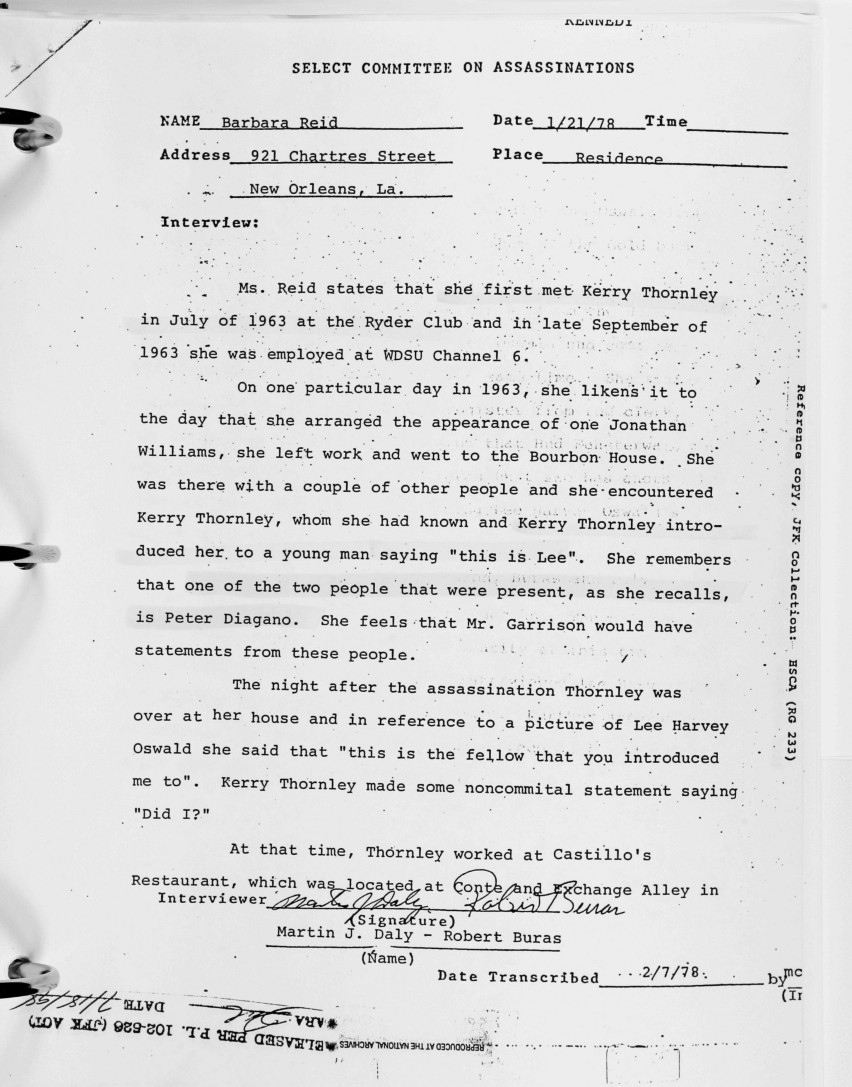
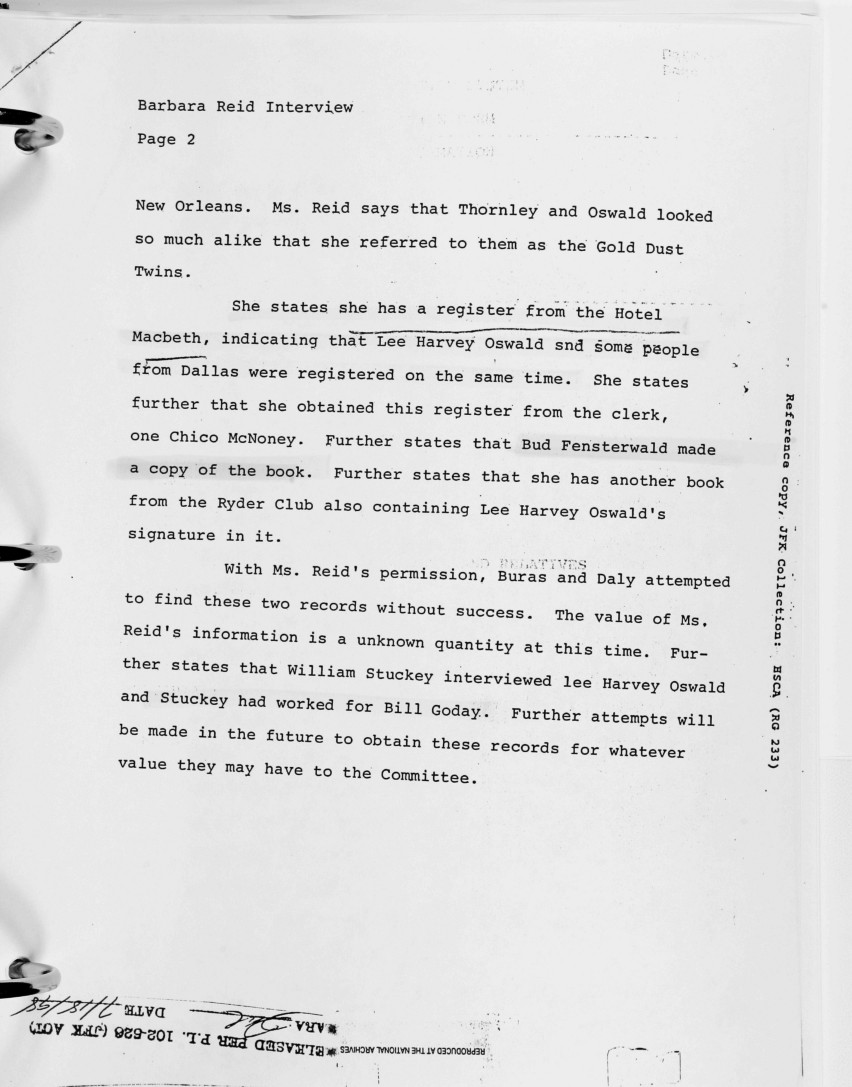
Reid’s claim that she told Oswald and Thornley they looked like “the Gold Dust Twins” is another little nugget that didn’t appear in her 1968 affidavit, suggesting that Reid later spiced up her story (during her 1978 interview with the House Select Committee on Assassinations) to fit with Garrison’s theory that Thornley was one of the notorious Oswald doubles.

Barbara Reid’s 1978 interview with the HSCA, page 00001.
Barbara Reid’s 1978 interview with the HSCA, page 00002.

Garrison’s claim that Thornley “wore his hair extremely long” has no substance. Thornley—as was the style of the day—let his hair grow long in the late 1960s, but the claim that he sported a new haircut to more resemble Oswald in 1963 is just another among Reid and Garrison’s impossible-to-prove-allegations.

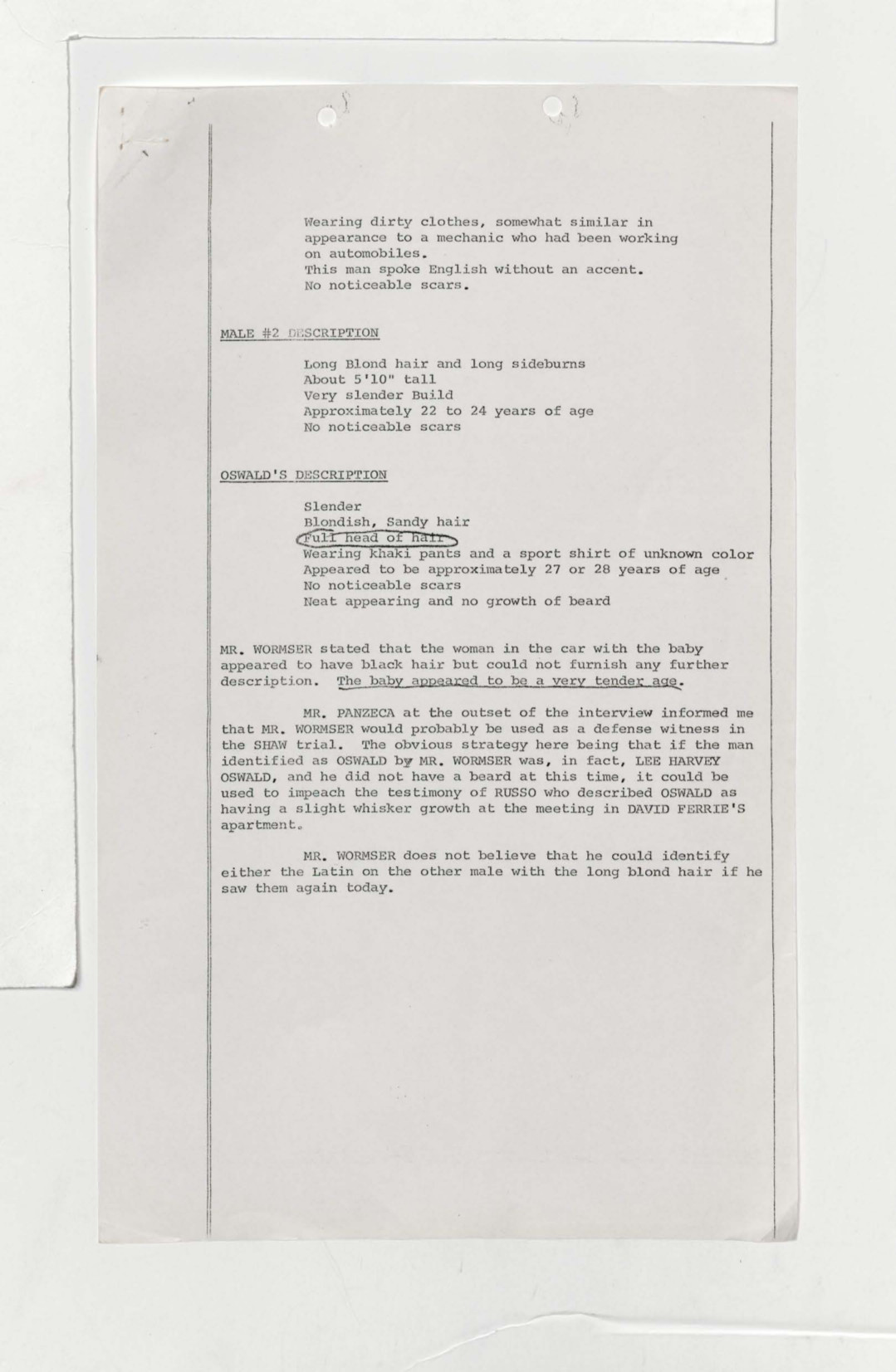
I suspect the reason Garrison glommed on to the notion that Thornley sported long hair may have been on account of a July 1967 memo (posted below) from Assistant District Attorney Jim Alcock documenting his interview with Clifford Wormser, owner of Cliff’s Junkyard in New Orleans.

Garrison Investigation memo from interview with Clifford Wormser,
owner of Cliff’s Junkyard in New Orleans, page 00001.
Garrison Investigation memo from interview with Clifford Wormser,
owner of Cliff’s Junkyard in New Orleans, page 00002.

According to Wormser, he was visited in September 1963 by Lee Oswald, his wife and baby, along with two other men, one a Latin looking fellow and the other a Caucasian with long blond hair. At the top of the memo, Garrison scribbled ‘Kerry Thornley’ indicating his suspicion that Thornley was one of the individuals accompanying Oswald during this junkyard visit.

Late September 1963 was the time-frame when Lee Oswald and Kerry Thornley were both in New Orleans during a 2 to 3 week period, which evidently led Garrison to theorize that the long blond haired fellow identified by Cliff Wormser was actually Thornley, and that Kerry cut his hair shortly afterwards. One of the problems with this scenario was that Thornley had brown hair, not blond.

Whatever the case, the apparent intent of Thornley cleaning up his act with this fresh new haircut (once again according to Garrison’s convoluted theory) was due to his recurring role as an Oswald double, which begs the question: If Thornley was masquerading as an Oswald double why would he have allowed himself to be seen in the company of Oswald? Wouldn’t that have potentially compromised the whole Oswald double caper?

Photo of a brown haired Kerry Thornley during the Summer of Love
that appeared in Open City magazine, 1968.

Garrison’s assertion in On The Trail of the Assassins that Thornley left New Orleans a few days following the assassination was also inaccurate, as it was actually three weeks after the assassination that Thornley moved to Arlington, Virginia on December 13th, 1963. This might seem like splitting hairs to some, but it only goes to illustrate how—when it came to Thornley—Garrison never got anything exactly right, and more often got it totally wrong.

To suggest that Thornley was difficult to locate was another fallacy perpetrated by Garrison to create the aura around Kerry as someone always in hiding or on the lam. At the time, Thornley was married with an infant child and held down dozens of menial jobs, while living at a few locations, in California and later Florida. He was also doing a lot of writing during this period, and his articles appeared in numerous publications. That Garrison encountered such difficulty tracking down Thornley says more about Big Jim’s dubious investigative skills than it does Thornley’s supposed elusiveness.

Garrison’s claim that the Ryder Coffee House had been Thornley’s main French Quarter hangout is also inaccurate. Kerry noted in his writings over the years that the Bourbon House—not the Ryder Coffee House—had been his main base of operations where he spent his idle hours writing or shooting the bull with other patrons. In recent correspondence with your humble author, Thornley’s French Quarter friend, Grace Zabriskie (formerly Grace Caplinger), confirmed that the Bourbon House was indeed Kerry’s main French Quarter hangout, and to a lesser degree, Carlos Castillo’s Mexican Restaurant.

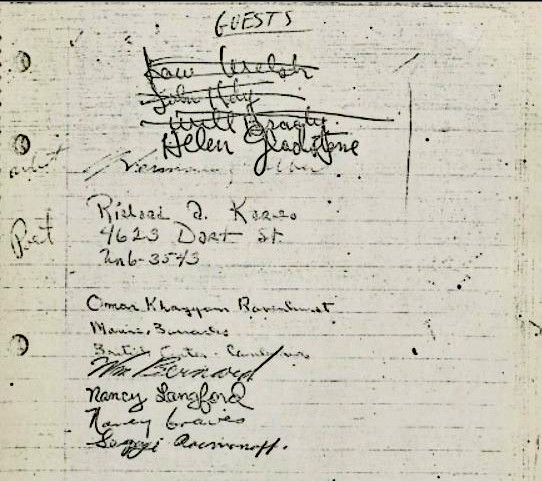
In regards to the Ryder Coffee House, Barbara Reid claimed she had evidence of Oswald and Thornley both signing the guestbook belonging to Jack Frazier, the manager of Ryder’s. In a memo from Harold Weisberg to Garrison, Weisberg noted that “several names may be disguised in this book, for example, Thornley’s in the ‘Discordian’ language on the ninth page. You have the Discordian files that I obtained on a previous trip. These will reflect which Omar Khyam is who….” 00002

Make of this what you will, but apparently Weisberg thought he was hot on the trail of a diabolical Discordian conspiracy and provided Garrison with copies of Frazier’s guestbook as evidence of this perceived diabolism. A review of the guestbook reveals that Thornley did indeed sign it using his Discordian moniker of Omar Khayyam Ravenhurst, which indicates that Thornley visited Ryder Coffee House on at least one occasion. However, there’s no evidence that Oswald—using his real name or an alias—ever signed the guestbook.

Robert Karno—who in the absence of Jack Frazier managed Ryder Coffee House during the relevant timeframe—stated in an interview with Asst. D.A. Jim Alcock that he thought he met Oswald at Ryder’s on one occasion, although he didn’t sound completely positive: “Well, I—I believe I did. I’m almost sure I did…” As for Thornley, Karno remembered meeting him there only once, as well, and said nothing about having seen Thornley and Oswald together. 00003

Ryder Coffee House guestbook signed by
Omar Khayyam Ravenhurst aka Kerry Thornley.

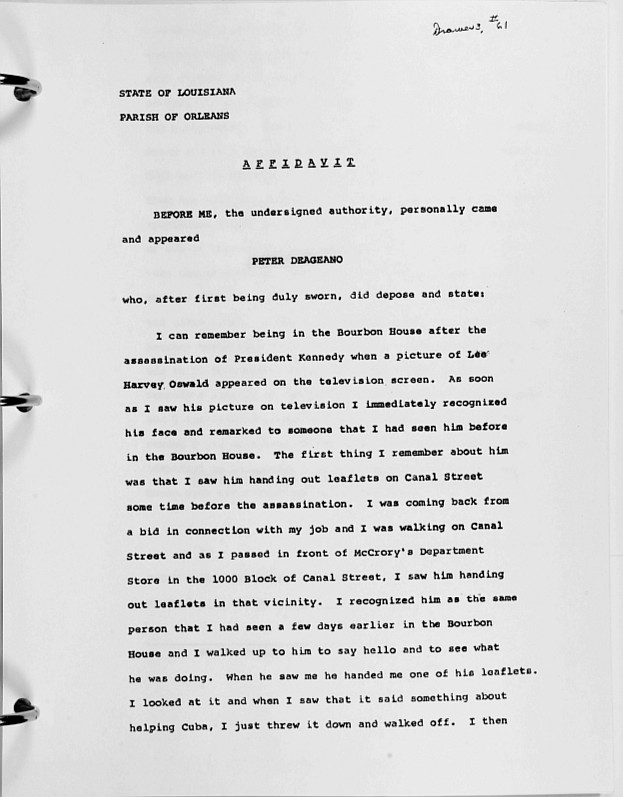
A second supposed witness to the Oswald/Thornley Bourbon House meeting was a French Quarter bookie named Peter Deageano. According to Deageano’s affidavit:

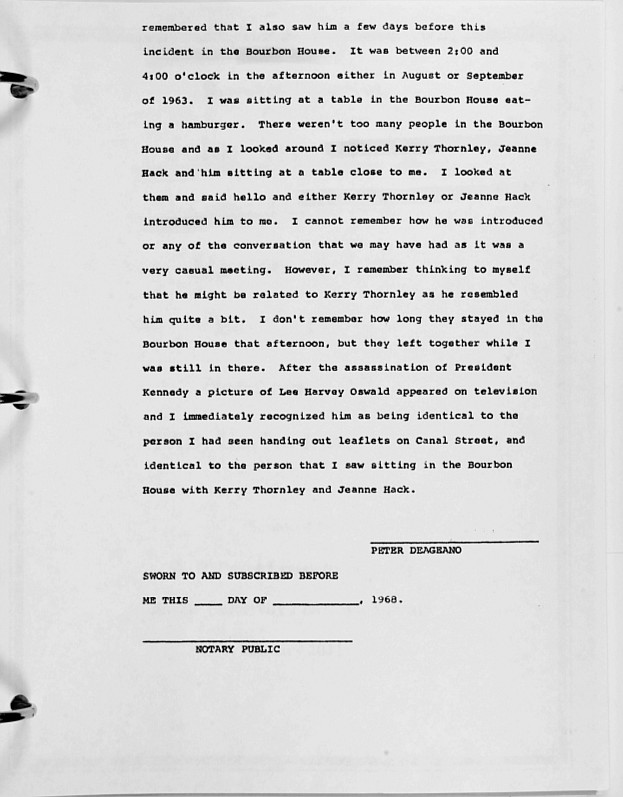
“It was between 2:00 and 4:00 o’clock in the afternoon either in August or September of 1963. I was sitting at a table in the Bourbon House eating a hamburger. There weren’t too many people in the Bourbon House and as I looked around I noticed Kerry Thornley, Jeanne Hack, and (Oswald) sitting at a table close to me, I looked at them and said hello and either Kerry Thornley or Jeanne Hack introduced him to me. I cannot remember how he was introduced or any of the conversation that we may have had as it was a very casual meeting. However, I remember thinking to myself that he might be related to Kerry Thornley as he resembled him quite a bit.

“After the assassination of President Kennedy a picture of Lee Harvey Oswald appeared on television and I immediately recognized him as being identical to the person that I saw sitting in the Bourbon House with Kerry Thornley…”

Although it’s not indicated in Deageano’s affidavit—which happened to be unsigned—he was in Barbara Reid’s company during this alleged Oswald/Thornley sighting. That Deageano’s affidavit remained unsigned speaks volumes (perhaps) to the methods of Garrison and his staff. Nowhere else in Garrison’s files does an actual interview with Deagano appear, and it’s my suspicion that Reid and/or the D.A.’s office drafted the affidavit, but when they presented it to Deagano he refused to sign it, assuming it was ever shown to Deagano at all.

Peter Deagano’s unsigned affidavit, page 00001.

Peter Deagano’s unsigned affidavit, page 00002.


For more about Barbara Reid and the Dealey Plaza Irregulars read Caught In The Crossfire: Kerry, Lee Oswald and the Garrison Investigation (Amazon) .

Read Part 1 of this series here.


00001 Jim Garrison, On The Trail of the Assassins, p. 70-72.

00002 3/17/68 memo by Harold Weisberg, http://jfk.hood.edu/.

00003 May 14, 1968 conversation between James L. Alcock and Robert Karno. Jim Garrison Papers, National Archives, John F. Kennedy Assassination Records Collection.

Categories
barbara reid book camden benares discordian timeline discordianism greg hill illuminati illuminet press jfk jim garrison kerry thornley lane caplinger lee harvey oswald monkey business official business principia discordia robert anton wilson robert newport robert shea video warren commission writings

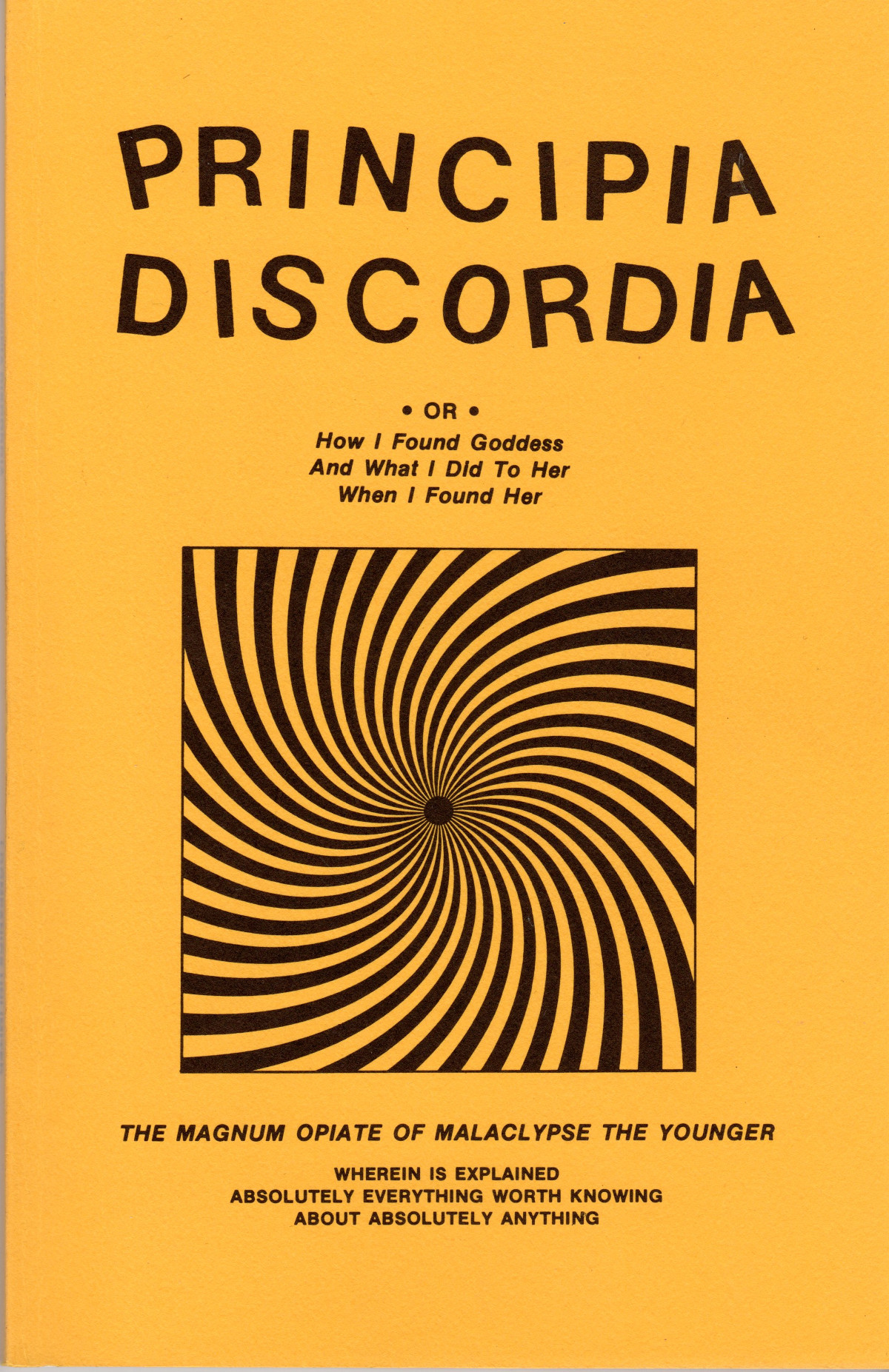
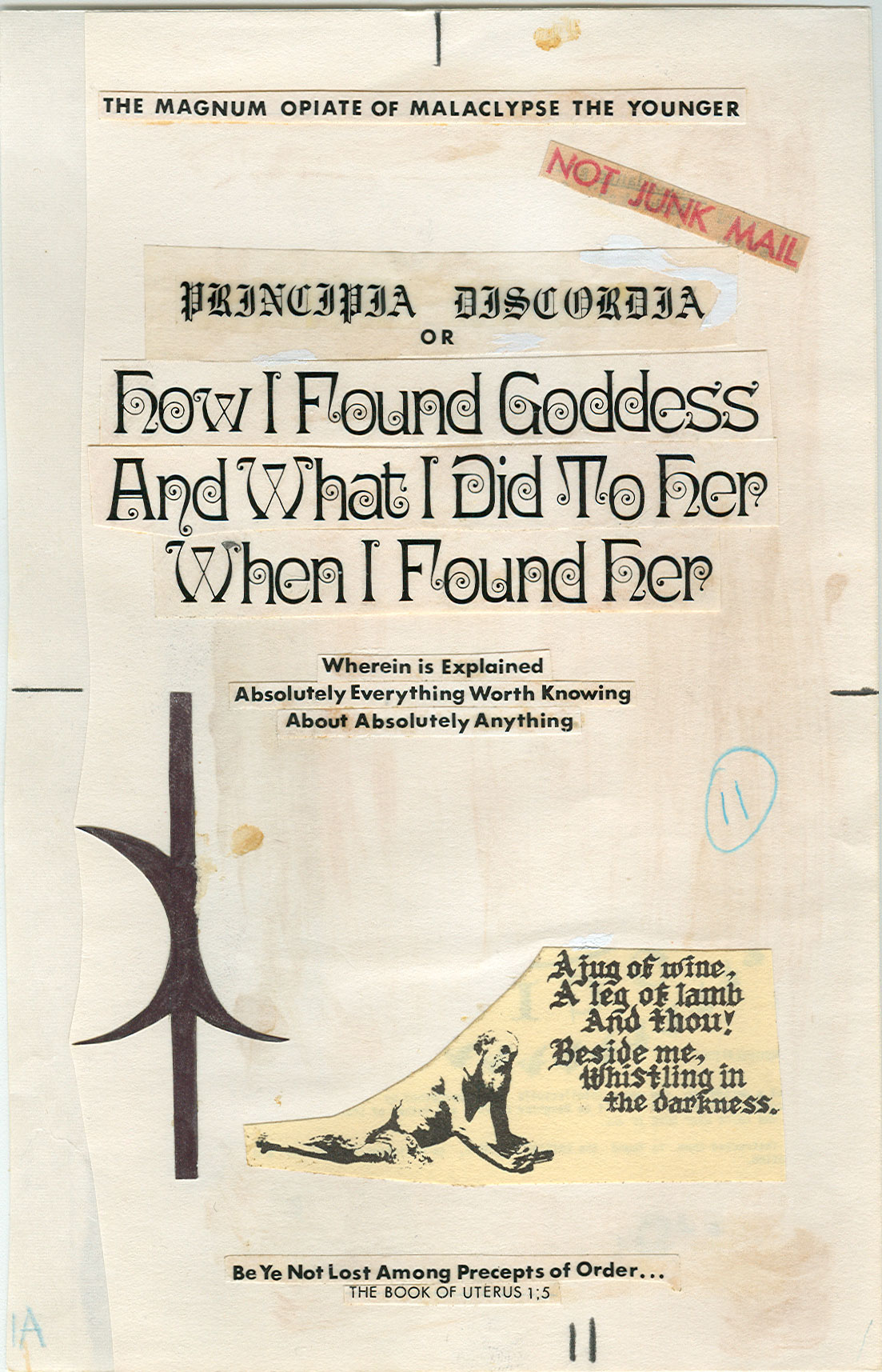
Principia Discordia: Celebrating 50 Years of Chaos! (Maybe!)

1980 yellow covered Loompanics edition of Principia Discordia.
 
Courtesy of the
Discordian Archives.
Prepare thyselves, O Discordians…

The Truth Shall Set You Confused… in 2,500 words or less!

2015 (or 3181 on the Discordian calendar) marks the 50th anniversary (maybe!) of the first edition of Principia Discordia, or How the West was Lost, published in New Orleans, Louisiana in 1965, consisting of a mere five copies that—according to Discordian co-founder Greg Hill—“were mostly lost.”

The details surrounding this rare 1st edition are enshrouded in as much myth and mystery as the JFK assassination itself, which—it so happens—will be forever linked to Discordianism due to its association with Discordian Society co-founder Kerry Thornley who served with Lee Harvey Oswald in the Marines.

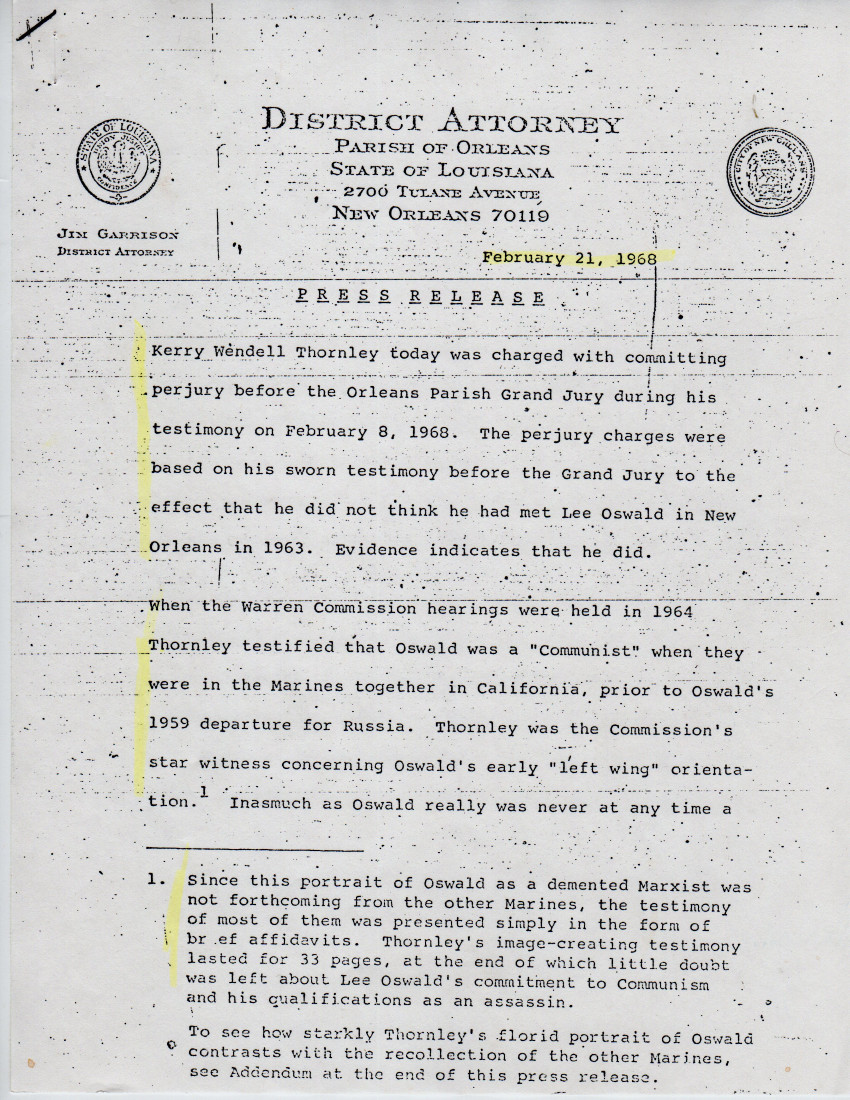
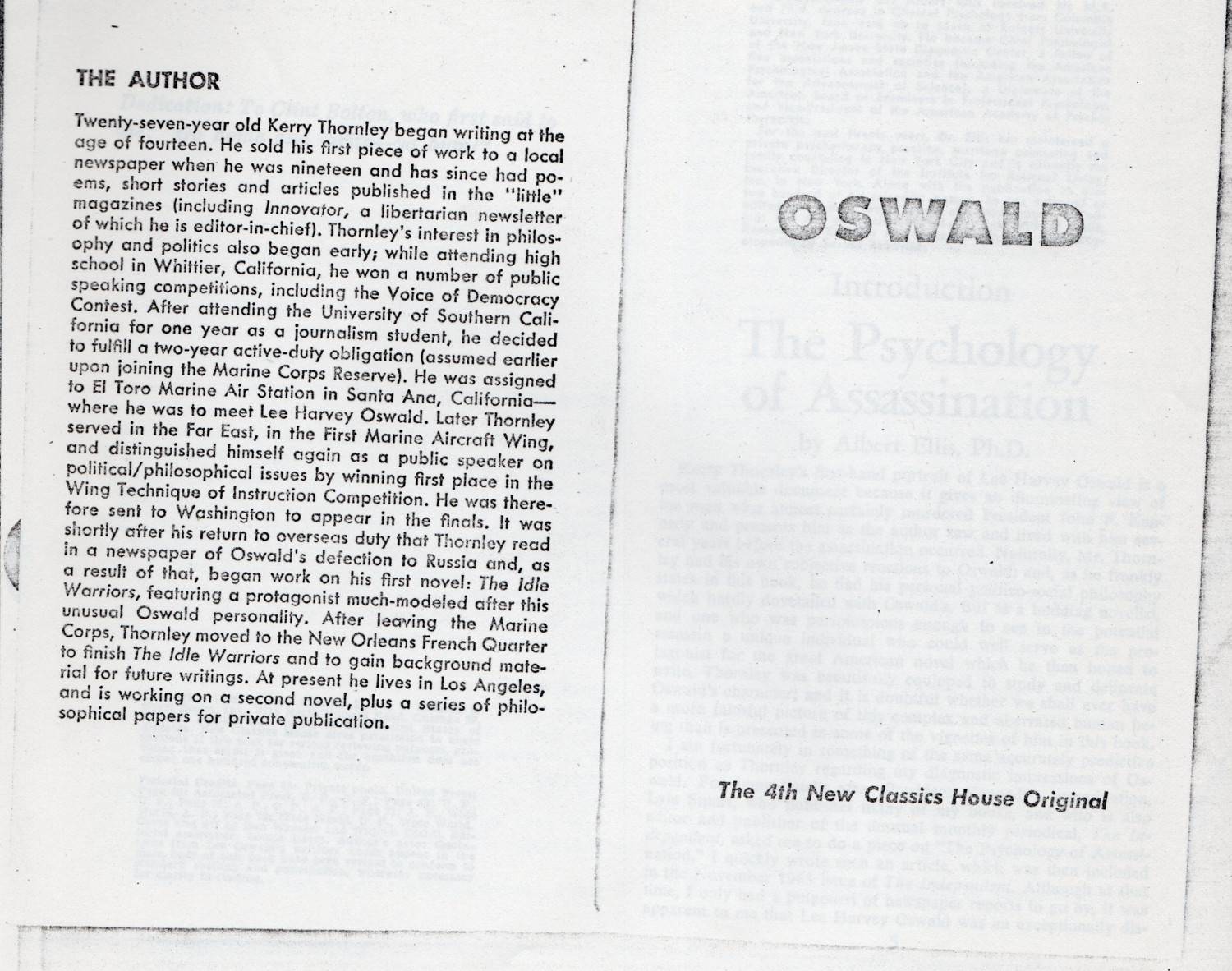
Curiously enough, Thornley was writing a book based on Oswald three years before the Kennedy assassination and afterwards testified before the Warren Commission and was later accused (ridiculously so) by New Orleans District Attorney Jim Garrison as being part of a JFK assassination conspiracy.

The Discordian Society included in its ranks such illuminated seers as Robert Anton Wilson (RAW) who noted in Cosmic Trigger: The Final Secret of the Illuminati: Volume 1:

“A search through the Discordian Archives revealed that the earliest of the Discordian holy books—How the West Was Lost, by Malaclypse the Younger (Greg Hill) — was originally printed on the Xerox machine of D.A. Jim Garrison, in summer 1963. (Greg’s girlfriend was Garrison’s secretary.)”

Thus was birthed the legend of how this mostly missing 1st edition was copied on a Xerox machine belonging to the very same man, Jim Garrison, who would later link Kerry Thornley to a shadowy cabal that allegedly orchestrated Kennedy’s awful offing.

Although RAW was partly correct regarding Jim Garrison’s association with the 1st edition Principia Discordia (PD), it appears that he might not have had his facts quite right. In the Loompanics edition of PD, Greg Hill added an afterword in which he corrected RAW’s claim about the Garrison copying machine caper:

“…Bob [RAW] says that when Oswald was buying the assassination rifle, my girlfriend was printing the first edition of Principia on Jim Garrison’s Xerox. It wasn’t my girlfriend, it was Kerry’s; it wasn’t the First Ed Principia, it was some earlier Discordian thoughts; it wasn’t Garrison’s Xerox, it was his mimeograph; and it wasn’t just before Kennedy was shot but a couple of years before that… The First Ed Principia, by the way, was reproduced at Xerox Corp when xerography was a new technology. Which was my second New Orleans trip in 1965. I worked for a guy on Bourbon Street who was a Xerox salesman by day.”

Afterwards, Hill received further clarification from Kerry Thornley, which he added as a footnote to his Loompanics afterword:

“I checked this further with Mr. Thornley. He says that the woman in question was not his girlfriend, she was just a friend, and it wasn’t a couple of years before Kennedy was shot but had to be a couple of years after (but before Garrison investigated Thornley).”

To confuse matters more (Hail Eris!), Thornley’s introduction to the IllumiNet Press edition of PD states:

“…the First Edition of Principia rolled off District Attorney Jim Garrison’s mimeograph machine (without his knowledge) in New Orleans in 1964. That was the work of Gregory Hill and of Lane Caplinger, a Discordian typist in the DA’s office.”

During the course of researching The Prankster and the Conspiracy: The Story of Kerry Thornley and How He Met Oswald and Inspired the Counterculture (2003 Amazon), I exchanged email correspondence with Lane Caplinger’s sister, actress Grace Zabriskie. For some reason, it’d never dawned on me to ask Grace about the legend of the 1st edition—probably because Grace, by her own choosing, was never really part of the Discordian scene.

In December 2012, I contacted Grace via email with some follow-up questions for my then book in the works Caught in the Crossfire: Kerry Thornley, Lee Oswald and the Garrison Investigation (Amazon) and at that time asked: Was the Garrison copying machine caper “truth, legend, or a combination of both?” Grace passed on my query to her sister Lane who replied, quite simply: “Legend. I recall occasional Discordianism reading and giggling only.”

Lane’s response now leaves us in a quandary and seems to put the kibosh on this whole wonderful mythos that the PD was created right under Jim Garrison’s nose by a diabolical Discordian conspiracy.

But wait, let’s not be in a hurry to dismiss the Garrison mimeograph legend. If we examine each of the seemingly conflicting stories regarding the origins of the 1st edition PD, I think in the final analysis there’s some measure of truth to each story, or as the old Discordian saying goes:

All statements are true in some sense, false in some sense, meaningless in some sense, true and false in some sense, true and meaningless in some sense, false and meaningless in some sense, and true and false and meaningless in some sense.

In the IllumiNet Press introduction to PD, Kerry Thornley identifies 1964 as the year of the publication of the 1st edition and that Greg Hill and Lane Caplinger were the culprits.

Thornley moved to Arlington, Virginia in late 1963 through 1964. Meanwhile, Greg Hill returned to New Orleans in 1964 and was there until mid-1965, which was the relevant period when the 1st edition was published.

My working theory is that Lane Caplinger did indeed run off some mimeograph copies of letters and writings by Hill and Thornley that later found their way into the first edition PD. However, it’s my impression that Lane had but a vague idea at best of what she was involved with—other than just copying some material for a couple of friends who were tinkering around with a joke religion called Discordianism.

As Greg Hill noted, only five copies of the 1st edition Principia Discordia were produced, most of which were lost. Later iterations of PD departed greatly from that long ago 1st edition, evolving into a collaborative art project that included the involvement of such notables as Robert Anton Wilson (Mordecai the Foul), Robert Shea (Josh the Dill), Camden Benares (The Count of Fives), Robert Newport (Rev. Hypocrates Magoun), Bob McElroy (Dr. Mungojerry Grindlebone)—and, of course, Thornley and Hill.

I first became involved in researching this craziness in the late-90s when I was overtaken with an obsession of writing a biography of Kerry Thornley, who had captured my imagination not so much due to my interest in Discordianism (that would come later) but because of all the other high weirdness surrounding his life.

In 2001, I initiated a Freedom of Information Act request for any Kerry Thornley related documents in the CIA and FBI files. Shortly after I was informed by the Feds that these Thornley FOIA materials had been previously released and were available through the National Archives. In short order, I obtained the materials, most of which had been assembled during the House Select Committee on Assassinations (HSCA) in 1977 and released to the public in 1992 through the Assassination Archives Research Center (AARC.)

In this Kerry Thornley-National Archives package were documents related to Jim Garrison’s investigation, including 36 Discordian related pages which didn’t mean a whole lot to me at the time as I was more interested in getting to the bottom of Thornley’s alleged Kennedy assassination associations than I was all of this Discordian doo-dah. If I’d been paying closer attention, I would have noticed that these Discordian related materials appeared to be the first edition of Principia Discordia, Or How the West Was Lost—or at least a collection of writings from the early days of The Discordian Society. These same materials were later identified in 2006 as the 1st edition PD by a fellow named Karl Musser, who came across the material during a visit to the National Archives.

National Archives version of Principia Discordia, Or How The West Was Lost.
Download PDF

At the time, Musser shared these documents with Discordian historian Dr. Jon Swabey who afterwards transcribed this apparent 1st ed. PD and posted it on the Internet via Creative Commons.

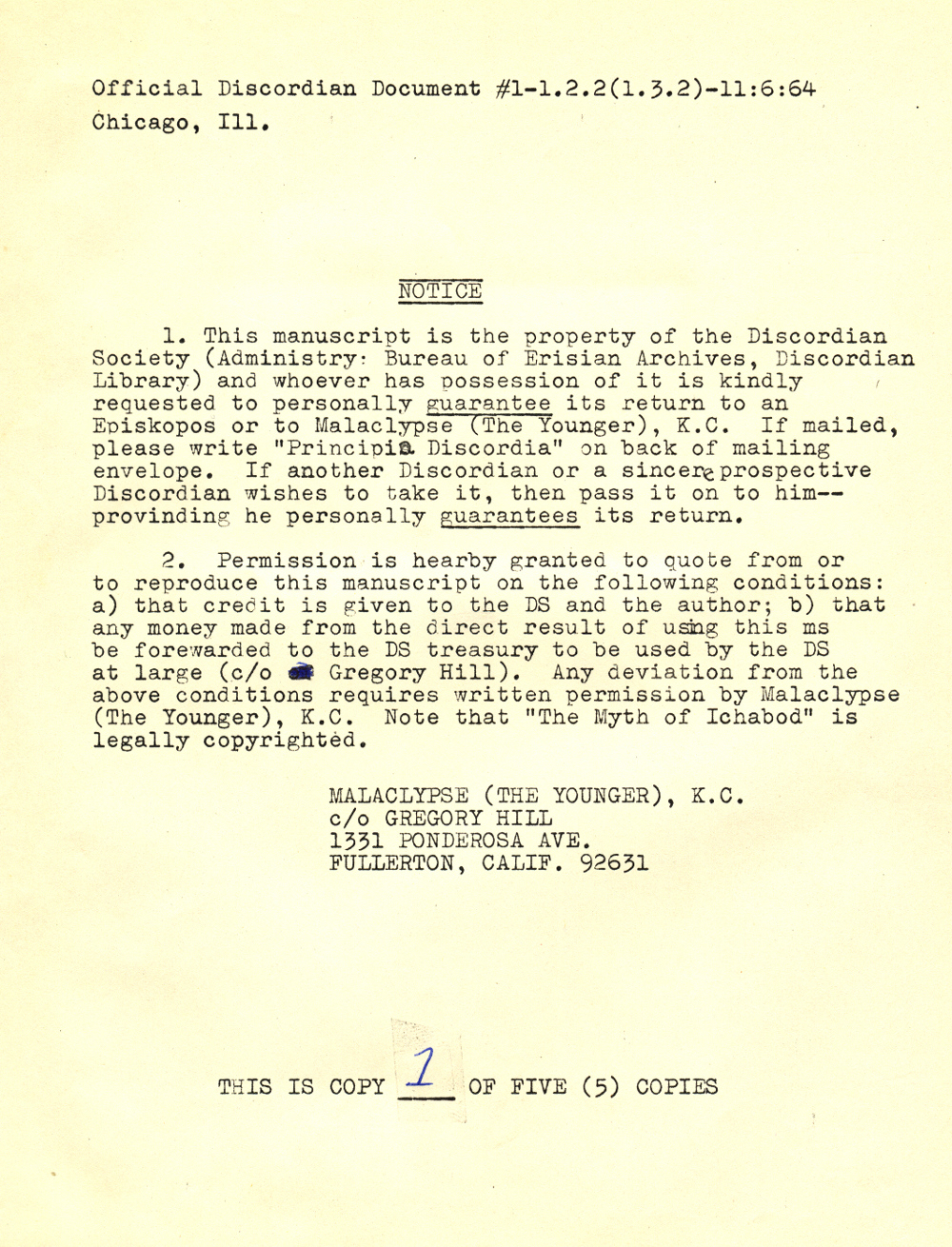
At the time, I was unaware that the Musser/Swabey tag team had brought to the Discordian world this apparent 1st edition PD. A couple years later, Dr. Robert Newport passed on to me Greg Hill’s Discordian Archives, consisting of all 5 editions of PD. However, the discovery of these different PD editions wasn’t immediately apparent and it took me some time to sift through the Discordian Archives and identity exactly what was what. The most amazing discovery of all was an actual honest-to-Goddess copy of the first edition of Principia Discordia, Or How The West Was Lost, numbered one of five, written in Greg Hill’s own hand.

Last page of the Discordian Archives version
of the 1st ed. Principia Discordia, numbered 1 of 5.

My discovery of the Holy Grail of Discordianism led to a period of intensive research into the history of PD. After a review of the Musser/Swabey/National Archives version of PD, I initially arrived at the conclusion (which I now consider erroneous!) that the National Archives version was a later and incomplete reproduction of the 1st edition PD. However, more recently I’ve come to suspect that the National Archives version is actually an early draft of PD.

For sake of clarity, I’ll henceforth refer to these two different versions of Principia Discordia, Or How The West Was Lost as: 1) the National Archives (NA) version, and, 2) the Discordian Archives (DA) version.

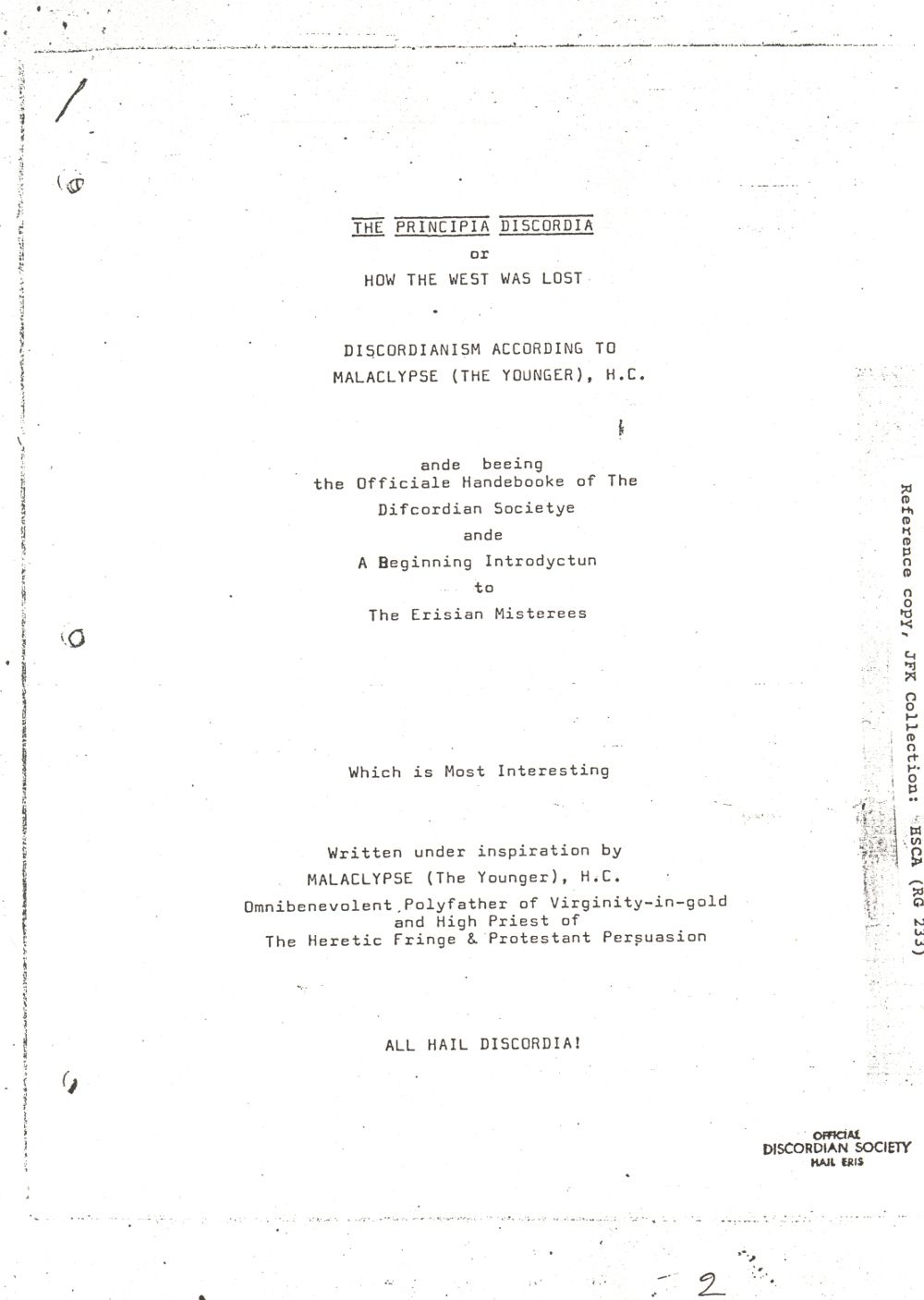
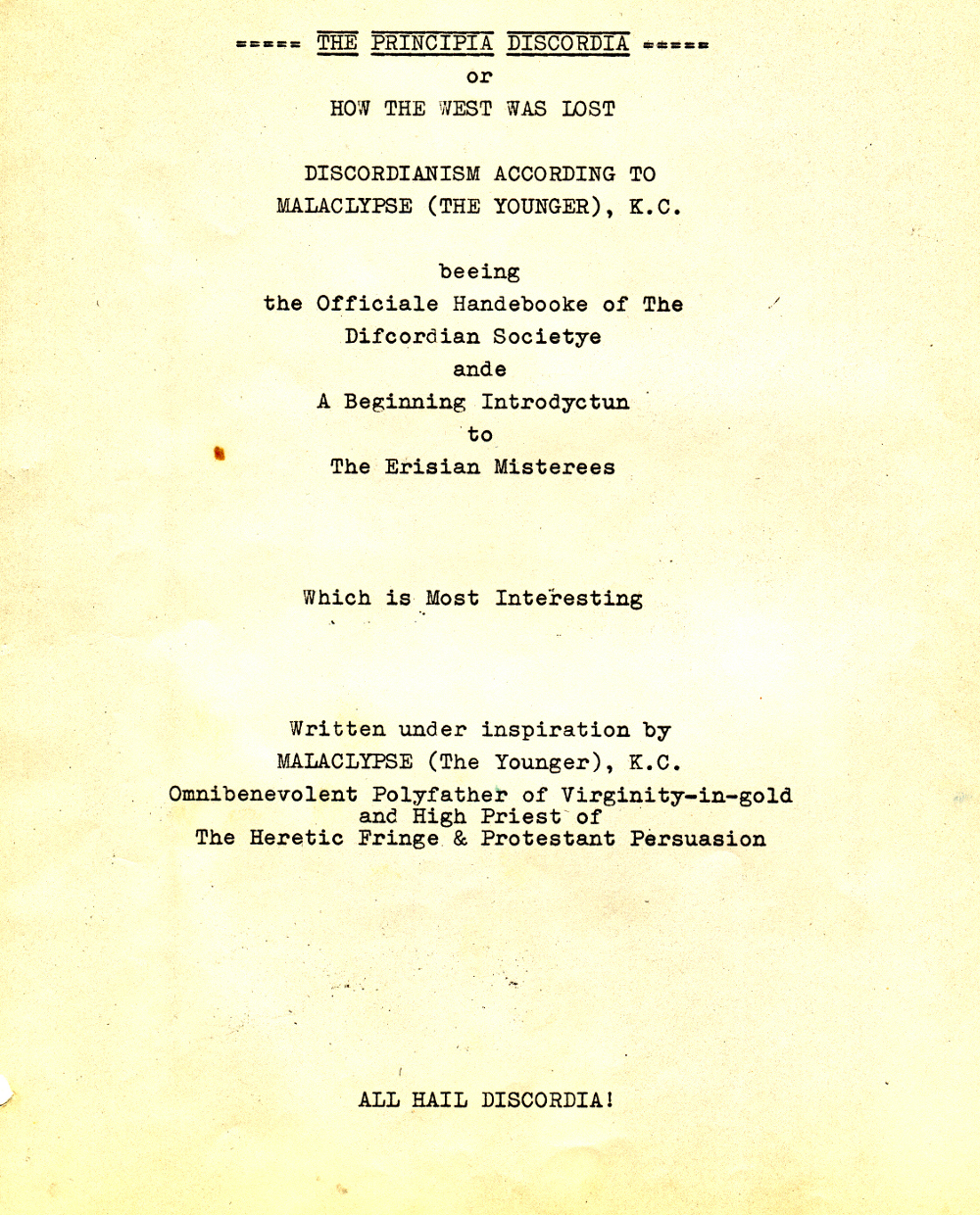
Although there are similarities between these two versions—the NA and DA—there are also a number of differences, one of which is the type font. Secondly, the NA version numbers only 36 pages while the DA version comes in at a whopping 60 pages including a number of illustrations that do not appear in the NA version.

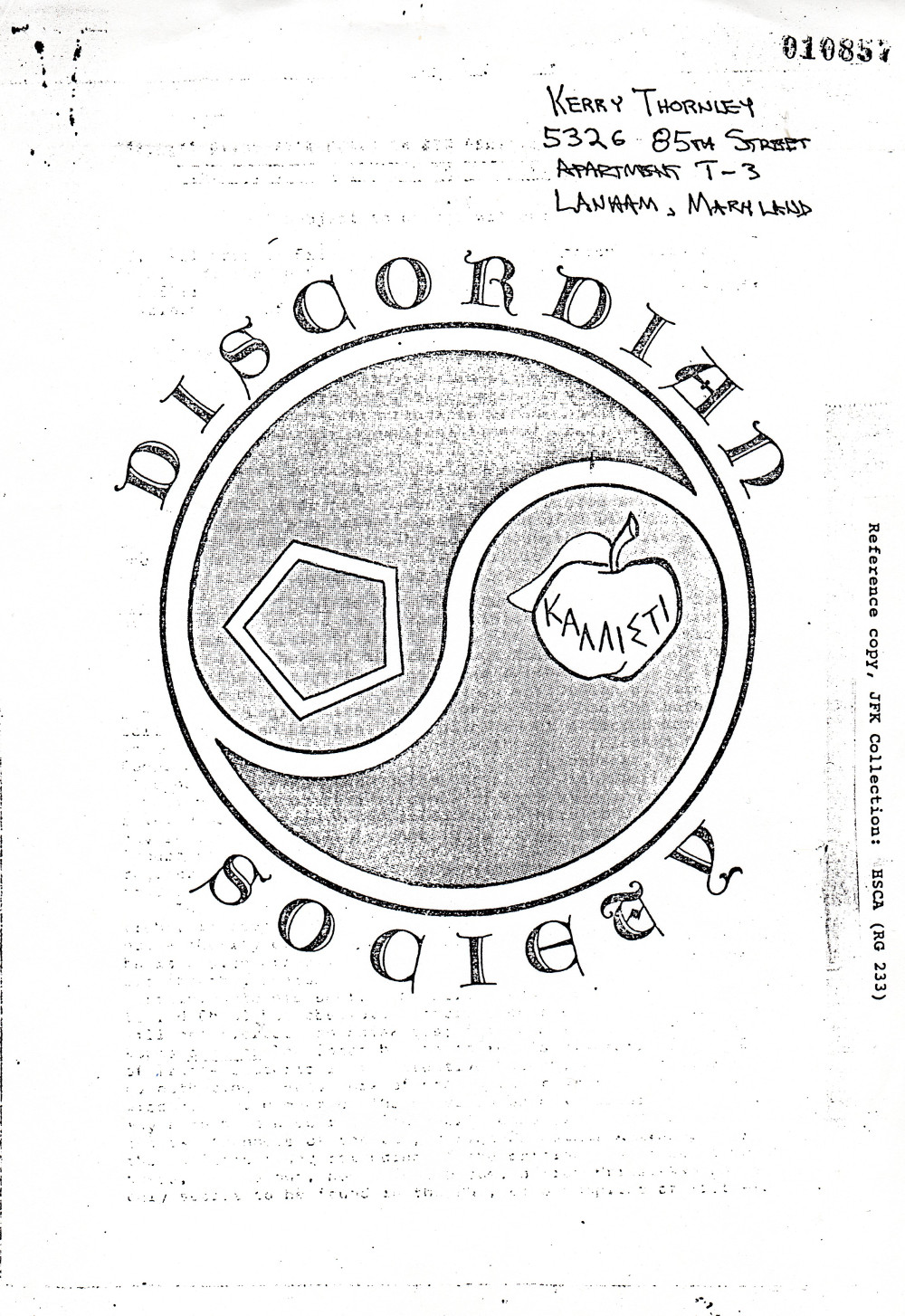
My reasoning behind this theory—that the NA version is an early draft of PD—is based, in part, on the handwritten address on the front cover:

Kerry Thornley
5326 85th Street
Apartment T-3
Lanham, Maryland

At first glance, I was a bit befuddled by this address because Thornley’s Warren Commission testimony stated that he’d moved to Arlington, VA in late 1963 and lived there until late 1964. But after giving it some thought, I remembered correspondence in the Archives where Thornley noted that he’d stayed for a period of time—in late-1963/early–1964—with his friend Robert McDonald in Maryland before his Arlington move. This provides further evidence that the NA version actually predated the DA version, and that some of the content in the NA version (as my theory goes) were pages Lane Caplinger ran off on Jim Garrison’s mimeograph machine.

Cover page of National Archives version of the 1st ed. Principia Discordia.
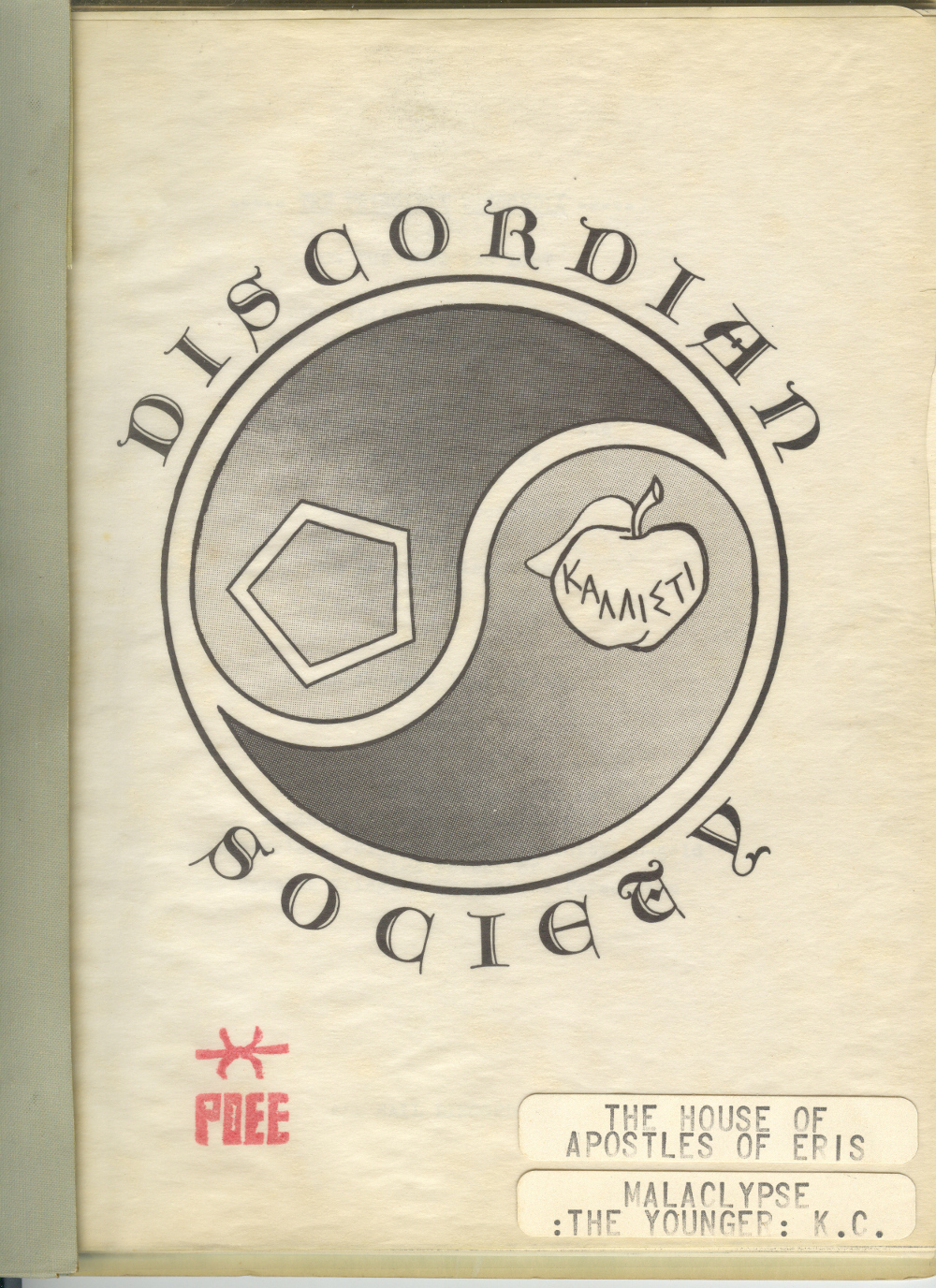
Cover page of Discordian Archives version of the 1st ed. Principia Discordia.

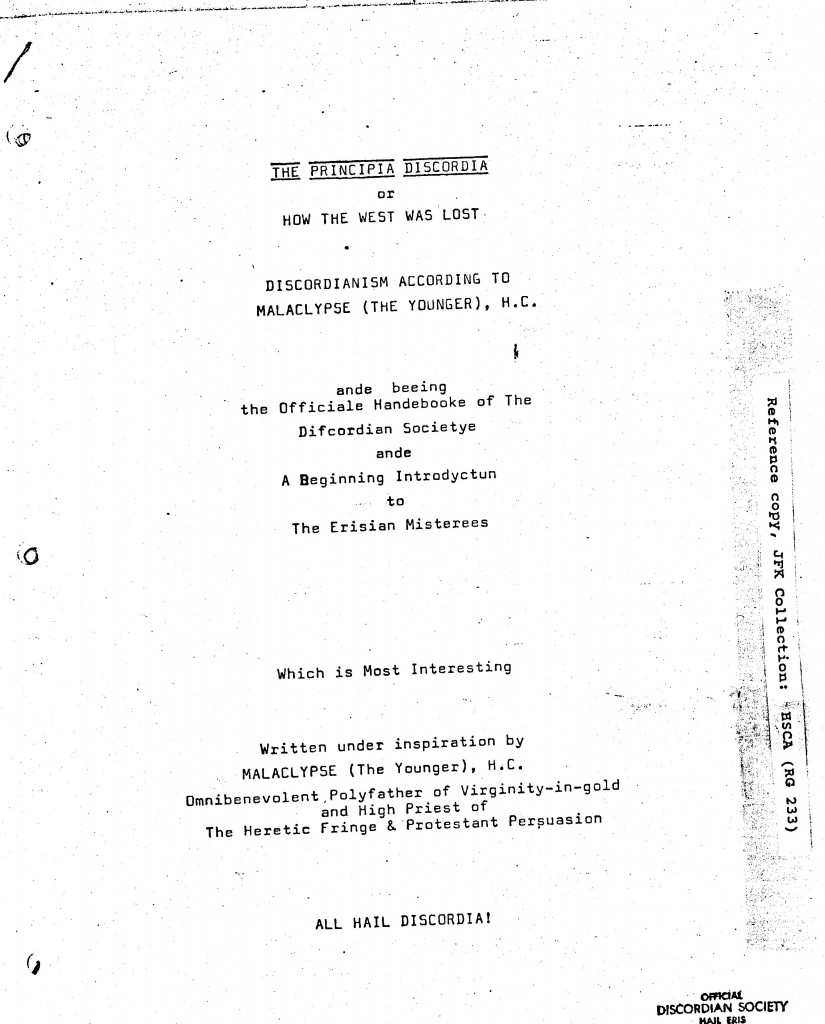
Additionally, my colleague Grouchogandhi pointed out that on the title page of the NA version the author is listed as “Malaclypse the Younger, H.C.” The curiosity, in this instance, is the title of “H.C.” In subsequent editions of the PD—including the 1st edition in the Discordian Archives (DA)—Malaclypse is referred to as “K.C.” (Keeper of the Chao) and in later editions as “K.S.C.” (Keeper of the Sacred Chao).

Title page of the National Archives (NA) version of the 1st ed. Principia Discordia.
Title page of the Discordian Archives (DA) version of the 1st ed. Principia Discordia.

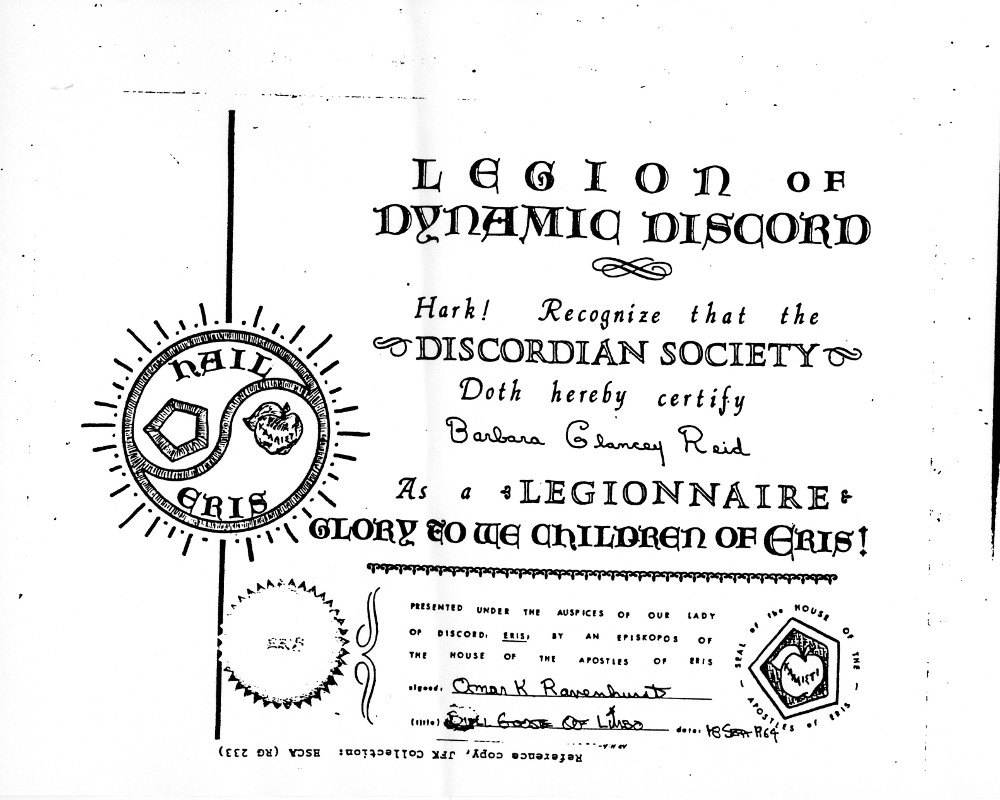
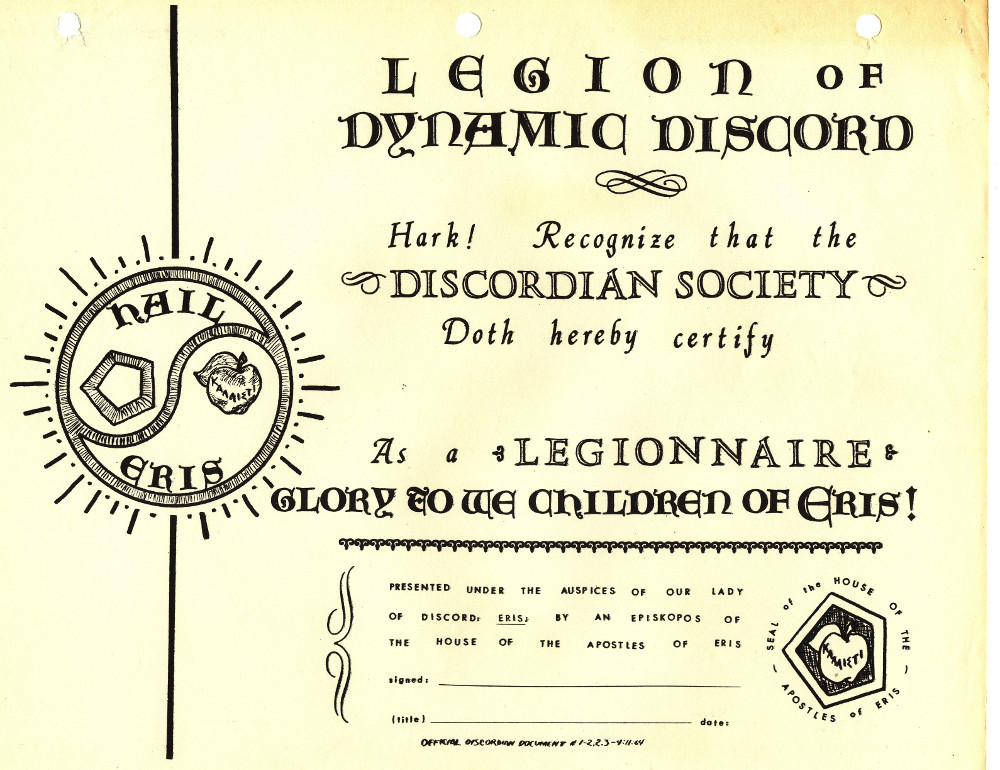
The third page of the NA version consists of a Legion of Dynamic Discord (LDD) certificate awarded to early Discordian Barbara Reid. Conversely, this certificate does not appear on the third page of the DA version. However, there is a blank LDD certificate on page 55 of the DA version, which suggests that the NA version was sent from Kerry Thornley (aka the Bull Goose of Limbo) to Barbara Reid in 1964 and included a signed LDD certificate as confirmation of Reid’s ordination into the Discordian Society.

Legion of Dynamic Discord certificate awarded to Barbara Reid which appears on page 3 of the National Archives (NA) version of the 1st ed. Principia Discordia.
Blank copy of Legion of Dynamic Discord certificate that appears on page 55 of the Discordian Archives (DA) version of the 1st ed. Principia Discordia.

So how, pray tell, did this early Principia Discordia draft wind up in the House Select Committee on Assassinations (HCSA) files? My guess is that Barbara Reid provided the document to the HSCA in the late-70s when she testified before the committee regarding her claims that she saw Kerry Thornley in the company of Lee Oswald in New Orleans in September of 1963. However, another person who might have submitted this document to the HSCA was assassination researcher Harold Weisberg, who worked closely with Barbara Reid during the Garrison Investigation period and entertained the notion, at one time or another, that the Discordian Society was some type of CIA front organization involved in the Kennedy Assassination dance party.

Hail Eris, indeed!


Adam Gorightly presents a brief introduction to the 1st edition of the Principia Discordia, courtesy of Brenton Clutterbuck of Chasing Eris.


Adam Gorightly presents the 1st through 5th editions of the Principia Discordia.

Categories
audio book camden benares discordian timeline discordianism john f. carr music official business photo video writings

Camden Benares’ List of Discordian Holidays

Early Discordian Camden Benares demonstrating How to Have Fun
and Be Happy.

According to John F. Carr, the following list of Discordian Holidays were part of a non-fiction work entitled How to Have Fun and Be Happy that Camden Benares wrote sensing a strong need for such a work.

Unfortunately, his agent was never able to sell it.

Adam Gorightly


Fun Friday

Fun Friday occurs four times each year. In any month that has five Fridays, the fifth Friday is Fun Friday, the symbolic anniversary of the day that Eris decided everyone should have more fun. This holiday is celebrated by doing anything that creates more fun for all.


JANUARY HOLIDAYS

 
1-1, Bogey’s Day

This anniversary of the birthday of Humphrey Bogart is celebrated by watching any of the 75 films in which he appeared.
 
 
1-5, Carioca Lodge Day

This is the anniversary of the founding of the Discordian Carioca Lodge in Rio de Janiero by the Portuguese Camho family and the Chinese Ho family. It is celebrated by eating Portuguese, Chinese, and Brazilian food, listening to Brazilian music, and watching Brazilian movies.
 
 
1-15, St. Afrodite’s Day

This is the day Discordians remember Aphrodite, the Greek goddess who became a Discordian saint when she transformed herself into the black beauty known as St. Afrodite. Celebrations usually include eating soul food and listening to rhythm and blues.
 
 
1-23, St. Bobcat’s Day

This is a celebration of the birthday of the son of Fred C. Dobbs and Sara Modrey, the famous Texan Discordian Robert Catman Dobbs, also known as St. Bobcat and the Dealey Lama. St. Bobcat devoted much of his life to aiding unfortunates who joined the Sub Dude cult. Discordians celebrate by saying hello to people named Bob and petting cats.
 
 
1-25, Liter Label Lark Day

The repackaging of alcoholic beverages according to the metric system was a Discordian project intended to prevent people from considering consumption of a fifth of liquor to be catma. Discordians who consume alcohol celebrate this day by having one drink. Discordians who don’t consume alcohol celebrate this day with a drink of golden apple juice.


FEBRUARY HOLIDAYS

 
2-2, Renew Old Acquaintances Day

Discordians celebrate this day by sending greeting cards to old acquaintances they haven’t been in touch with lately.
 
 
2-5, Dadanova Day

Dadanova is the famous Discordian art movement. The day is celebrated by creating and sharing art.
 
 
2-14, St. Heat’s Day

In remembrance of the great love that Valentine Heart and Valentina Heart had for each other, Discordians spend time having fun with those they love.
 
 
2-15, Lupercalia Transmogrified

Lupercalia is an ancient Roman holiday concerned with sex and abundance. Discordians are encouraged to develop their own rituals and ceremonies for this holiday.
 
 
2-23, Didyme’s Day

This holiday is in memory of the Dogon-Greek oracle who read tarot cards for Eris. Appropriate ceremonies are those which forecast the future or demystify the present. The following poem by Didyme Thelema’s lover, Asklepiades, is usually read aloud:

Didyme plunders me with her beauty.
When I look at her I am wax over fire.
If she’s black, what of it? So are coals.
When kindled, they glow like blooming roses.


MARCH HOLIDAYS

 
3-3, Pass Day

This is the day Discordians pass on the things they don’t want. Special celebrations are held in Pasadena, Pascagoula, Pashkovo, Passaic, and Passo Fundo. Some Discordians pass out free cards which read:


F R E E   P A S S

THIS PASS ENTITLES THE BEARER TO PASS BY ANY OPTIONAL OPPORTUNITIES AT ANY TIME. GOOD FOREVER OR UNTIL NEXT TUESDAY, WHICHEVER COMES FIRST. COURTESY OF THE DISCORDIAN SOCIETY.


3-5, Self-Esteem Day

On this day any Discordian may award herself or himself any honor, degree, or title that seems appropriate.
 
 
3-15, Turkey Vulture Day

Discordians celebrate this day by facing toward Hinckley, Ohio, where the turkey vultures roost, and by listening to Simon and Garfunkel’s recording of “El Condor Pasa.”


3-17, Rex Saxonda Film Day

Discordians celebrate by brushing the film off their teeth and watching any motion picture film. Rex believed that every film had value regardless of content.
 
 
3-19, St. Swallow’s Day

This is the time for remembrance of St. Swallow who spent years breeding swallows with homing pigeons. The faithful face Capistrano and swallow five times. There is no requirement as to what is to be swallowed. Some skeptics believe that people who celebrate this day will swallow almost anything.


APRIL HOLIDAYS

 
4-4, Square Day

Discordians celebrate this day by finding fun in the ordinary. Square dancing to Steve Allen’s “Very Square Dance” is encouraged. At least five minutes of television should be watched as part of the celebration.


4-5, Be Kind To Tourists Day

Discordians celebrate this day with random acts of kindness to tourists. Those who find this difficult to do can go some place out of town and pretend to be tourists.
 
 
4-15, Break Day

This is the day all Discordians recognize their value and give themselves a well deserved break.
 
 
4-29, Duke’s Day

This is Duke Ellington’s birthday, celebrated by listening to, singing along with, or dancing to the music of this American master of music.


MAY HOLIDAYS

 
5-1, Adam Weishaupt’s Day

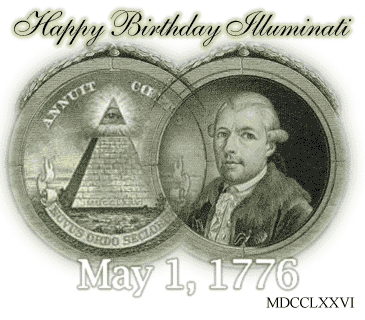
This day is the anniversary of Adam Weishaupt’s founding of the Bavarian Illuminati, rumored to be a front organization for promoting Discordianism. Discordians celebrate by eating Bavarian cake and watching traffic until five autos from the Bavarian Motor Works (BMW) pass.
 
 
5-5, St Gulik’s Day

St. Harvey Gulik, Guardian of the Gentle and Protector of the Harmlessly Weird Ones, is honored on this day. St. Gulik’s familiar was the rabbit so eating a rabbit made from chocolate candy is an appropriate act. Watching the motion picture Harvey, inspired by St. Gulik, is considered an act of devotion.
 
 
5-15, Tree Day

Discordian celebrate this day by planting a tree, thinking of five apple trees, or thinking of one apple tree five times.
 
 
5-23, Buddha’s Birthday

Although the evidence that Buddha was a Discordian is circumstantial and anecdotal, Discordians celebrate Buddha’s birthday by saying “Happy Birthday, Bud.” Discordians who are especially devout read aloud from Discordian Zen Buddhist texts such as Zen Without Zen Masters, A Handful of Zen, and Riding Buddha’s Bicycle.
 
 
5-25, Creation Day

This is the anniversary of the Erisian creation of all chaos. Discordians celebrate this day by chanting the Discordian Taoist truth:

“Creation and creator are one; there is no creator separate from creation.”


JUNE HOLIDAYS

 
6-5, Golden Apple Day

This is the day when each Discordian is entitled to award herself or himself the Golden Apple Achievement Award for outstanding achievement in Discordianism.
 
 
6-6, St. Helen’s Day

This is the day that St. Helen of Troy is honored. She apologized to Eris for her unintentional part in the Trojan War and became a Discordian. When last heard from, the reincarnated Helen was working as a waitress at Ships Coffee House where it was said that she had the hips that brought a thousand tips.
 
 
6-15, Liberation Day

On this day Discordians remind themselves that their lives are much better since they considered themselves liberated.
 
 
6-23, Unknown Saints Day

Since all Discordians are considered saints according to the holy writings of Omar and Malaclypse, this day honors all the Discordians whose names are unknown.
 
 
6-25, Know Saints Day

On this day, Discordians honor the other four categories of Discordian saints: living saints, dead saints, fictional saints, and imaginary saints.


JULY HOLIDAYS

 
7-4, Hodge Podge Lodge Day

This is a celebration of the founding of the first American Discordian lodge by Adam Weishaupt after he fled Bavaria and came to America where he initiated George Washington and later impersonated him. Johnny Appleseed was also initiated by Adam in this lodge. The celebration consists of eating an apple while looking for Discordian symbolism on a one dollar bill.
 
 
7-5, Freedom Day

This is the day Discordians celebrate being free of the religious dogma that clogs the pathways of so many brains.
 
 
7-7, Mirror Compliment Day

On this day, Discordians look into their mirrors and compliment the mirrors on having the good taste of having such a wonderful, fun-loving owner.
 
 
7-14, St. Merde’s Day

This is the day Discordians congratulate themselves on turning the crap of their lives into fertilizer.


7-23, Jack Slack’s Day

Jack Slack is honored this day for his work in guru liberation, liberating gurus from their mistaken beliefs that they are channels for liberation.


AUGUST HOLIDAYS

 
8-5, St. Otis the Elevated’s Day

On this day Discordians celebrate the elevation of St. Otis by riding in an Otis elevator.
 
 
8-8, St. Pythagoras’s Day

St. Pythagoras was fascinated by the number eight. On this day Discordians do eight things that bring more fun for everyone.
 
 
8-15, Theatre Night

On this night, Discordians gather at 8:15 before any theatre that has an 8:30 curtain time and entertain those patrons standing in line until they are admitted.
 
 
8-23, Nancy Fancymanner’s Birthday

Nancy is remembered by her great contribution to Discordian style. She was the one who said, “Acquiring Discordian style is a matter of individual chaotic subtlety while being fashionable or trendy is merely a willingness to follow herd instinct.”
 
 
8-30, St. Scrivener’s Day

On this day Discordian writers are honored by other Discordians who read aloud from published works.


SEPTEMBER HOLIDAYS

 
9-9, Eris’s Birthday

Discordians celebrate Eris’s birthday on this date because no one is certain what the correct day is. Greek food and golden apples are usually served.
 
 
9-17, Emperor Norton’s Day

This is the anniversary of the day in 1859 that San Francisco Discordian Joshua Abraham Norton issued a proclamation declaring himself Emperor of the United States. Discordians celebrate by reading aloud the Emperor’s proclamation which is reprinted here.

PROCLAMATION

At the peremptory request of a large majority of the citizens of these United States, I, Joshua Norton, formerly of Algoa Bay, Cape of Good Hope, and now, for the past nine years and ten months of San Francisco, California declare and proclaim myself Emperor of the United States, and in virtue of the authority thereby in me vested do hereby order and direct the representatives of the different States of the Union to assemble in the Musical Hall of this city on the first day of February next, then and there to make such alterations in the existing laws of the Union as may ameliorate the evils under which the country is laboring, and thereby cause confidence to exist, both at home and abroad in our stability and integrity.
Norton I, Emperor of the United States


9-23, Dog Star Day

On this day, Discordians celebrate the existence of Sirius, the Dog Star, legendary home of the Nommos, space travelers who visited this planet before the Trojan War. This holiday may be celebrated in five ways:

  1. Eating a hot dog
  2. Looking at a dogwood tree
  3. Singing any song with dog in the lyrics
  4. Petting a dog
  5. Telling shaggy dog stories


9-25, Erotic Terrorism Prevention Day

This day marks the founding of the Erotic Terrorism Protection League by Felix Pendragon. Erotic terrorism is defined as activity related to sex for the purpose of scaring one or more bystanders or observers. On this day Discordians expand their knowledge of sex to protect themselves from erotic terrorism. One method is to read the following poem by Felix Pendragon:

THE ABC’S OF EROTIC
TERRORISM PROTECTION

Autoeroticism is sex for one.
Brothels charge money for all sexual fun.
Condoms for safe sex are a must.
Dirty pictures show people in lust.
Exhibitionism is showing it all.
Fetishism is weirdness having a ball.
Genital identification is hard to fake.
Hedonism is sex for pleasure’s sake.
Inhibition is what you can lose.
Jailbait is someone too young to choose.
Kinky people to strange sex aspire.
Libido is a name for sexual desire.
Masturbation remains the safest sex play.
Narcissists love themselves in every way.
Obscenity is in the mind of the beholder.
Puberty comes as a child grows older.
Quckie is sex done in a hurry.
Randy is horny to the point of worry.
Satyr is a male who can’t say no.
Tart is a female ready to go.
Uprighters have sex while they stand.
Voyeurs think sex watching is grand.
Yodeling is much more oral than not.
Zoophiles find animals make them hot.


9-30, Kokomo Dragonlady’s Day

This day honors Kokomo Dragonlady, the Indian from Indiana, who promotes the safest sex through her mail order organization, Sex Without Partners. Kokomo claims to be a spiritual and perhaps a physical descendent of Johnny Appleseed. She requests that on this day Discordians plant their seeds in her name.


OCTOBER HOLIDAYS

 
10-5, Inexpensive Gift Day

On this day devout Discordians show self-appreciation by giving themselves an inexpensive gift.
 
 
10-10, Hildegarde’s Night

Bewitching Hildegarde was famous for her on-campus tricks, usually performed at night. Discordians tell stories of the sexual escapades of Hildegarde who was famous on ten campuses and captured the heart of Georgia Tech’s most famous student, George P. Burdette.
 
 
10-23, Hugo Troy Tutlege, Jr.’s Birthday

Gift’s are optional on this day because Hugo is the richest Discordian in the world. He is honored for financing the liquor liter label lark, the Discordian Street Theater Extravaganza, the Discordian Players Group Spectacular, and the Weird Oral History Organization (WOHO). In person, Hugo is elusive and a bit of a loner. There is no record of him ever having been seen by two people at the same time. The most common thing said about Hugo is, “Hugo was here. He just left.” This day may not be Hugo’s actual birthday but is derived from his favorite verse of his favorite song, “Chisholm Trail,” namely:

I started up the trail October twenty third
And I throwed my rope in a big cow turd.
Come a ti yi youpy, youpy yea, youpy yea
Come a ti yi youpy, youpy yea.


10-31, Discordian Saints Day

Most Discordians use the day to honor their favorite Discordian saints, including themselves.


NOVEMBER HOLIDAYS

 
11-5, Motion Picture Day

This is the day that Discordians look for both obvious and subtle references to Discordianism in any film they watch.
 
 
11-11, St. Yossarian’s Day

Since eleven plus eleven equals twenty two, Yossarian, the military navigator in the book Catch-22 and the film of the same title is honored on this day. When Yossarian realized that war was crazy and that being in a war was driving him insane he became the Discordian Saint of Military Intelligence. Discordians remind themselves on this day that any civilian outranks all military personnel.
 
 
11-23, Romance Day

Discordians on this day think romantic thoughts and recall the famous romantic marriage of Zelda Harrington and Felix Pendragon.
 
 
11-25, Literary Saints Day

On this day Discordians read aloud incidents of Discordian Saints in fiction and in other works containing fiction disguised as nonfiction.
 
 
11-30, Early Lunch Day

This is the day that Discordians eat lunch at 11:30 a.m.


DECEMBER HOLIDAYS

 
12-1, Rosetta Stone’s Birthday

This is the day Discordians remember St. Rosetta Stone by looking at stones in a rose garden.
 
 
12-7, Buddy Darma’s Day

On this day Discordians sing “My Buddy” and look for catma in weird publications.
 
 
12-23, Dragon Clan Anniversary Evening

On this evening Discordians recall and celebrate the Dragon Clan’s victory over erotic terrorism forces. Achievements are exaggerated and some lies are told.
 
 
12-25, Jay See Fitzdragon’s Birthday

The ideal celebration for this holiday is listening to bootleg recordings of the first Discordian rock band, Jay See and the Disciples of Eris. The rarity of these recordings causes most Discordians to celebrate in some other manner befitting the occasion.

Categories
art book brunswick shrine daisy eris campbell discordianism hilaritas press music official business play robert anton wilson writings

Discordian News Roundup

Inspired by last year’s production of Daisy Campbell’s Cosmic Trigger Play and Find the Others Festival, an intrepid group of Discordians across the pond are crowdsourcing a Disco free-for-all called Festival 23 slated for the weekend of July 23rd, 2016 that is described as “An interactive celebration of literature and the arts; of theatre, playshops and music inspired by the Discordian movement; a society of philosophers, theologians, magicians, scientists, artists, clowns and similar maniacs who are intrigued with Eris, Goddess of Confusion, and with her doings.”

One of the organizers of the Festival 23 event recently appeared on the Cult of Nick which you can hear here.

Hear, hear!

Word on the street is that Daisy Campbell and her band of merry misfits will also be involved with Festival 23, all of which will presumably keep the Golden Apple rolling in a positive direction all the way to Santa Cruz, California where Daisy and the troops intend to stage the Cosmic Trigger play in 2017—on July 23rd to be exact—the same date of the annual Robert Anton Wilson Day in Santa Cruz as well as the day when RAW originally pulled the cosmic trigger back in 1973, which is what all this fuss is about.

For more of a tease, read Daisy’s update here.

To coincide with all these Cosmic Trigger related happenings, the RAW estate has just announced the official launch of its publishing arm Hilartius Press and re-release of a whole slew of RAW titles. First out of the chutes will be—you guessed it!—Cosmic Trigger I: The Final Secret of the Illuminati with a brand spanking new intro by John Higgs author of the fabulous Discordian title KLF: Chaos Magic Music Money that if you haven’t read, you really should, and quickly.

Brunswick Shrine: A Sign From Eris.
Courtesy Discordian Archives.
And if all of that wasn’t enough jolly good news to keep all you greyfaces out there from totally immanentizing the eschaton, Tom Jackson over at rawillumination.net just the other day reported that the fabled Brunswick Shrine has apparently been rescued from the wrecking ball!

Hail Eris! All Hail Dick Weber!

Categories
audio book brunswick shrine discordian timeline discordianism floyd anderson greg hill illuminati illuminatus! interview jfk kerry thornley lee harvey oswald official business principia discordia robert anton wilson robert shea video writings

Adam Gorightly Interviewed by Jim Harold — Discordianism, Kerry Thornley, 23

Gorightly interviewed by Jim Harold on Discordianism, Kerry Thornley, 23, The Church of the SubGenius, Robert Anton Wilson, and more!

http://jimharold.com
http://jimharold.net

http://www.adamgorightly.com

Video by Floyd Anderson located here on The YouTube.

Categories
book discordian timeline discordianism greg hill illuminatus! illuminet press kerry thornley principia discordia robert anton wilson robert shea writings

The State of the Art of Research on Discordianism by Christian Greer

Christian Greer
Despite numerous attempts to analyze its history, symbols, practices, and beliefs, scholarship on Discordianism has been largely deficient. The most pressing problem is that scholars have neglected the majority of Discordianism’s primary source materials, and are thus unable to provide the necessary contextual understanding for the readily available texts (and web-resources) they do study. The effect is that academic treatments of Discordianism have essentialized the religion according to a small, self-selected number of commercial publications entirely removed from their historical context.1  

One of Discordianism’s two founders, Kerry Thornley, famously declared that if ‘religion is the opium of the masses, [then] Discordianism is the marijuana of the lunatic fringe,’ and this is made nowhere more clear than in its material culture over the last fifty-six years.2   The majority of Discordianism’s material culture has been comprised of self-published work in the form of religious certificates, ‘zines’, APAs (amateur press associations), live audio recordings of Robert Anton Wilson lectures, and, with the advent of the internet, BBSes (Bulletin Board System), PFDs, and blogs.3   The paper ephemera of Discordianism’s material history has not been catalogued by libraries, nor preserved by universities, but commonly remains in the possession of its initial recipients, or forgotten in the boxes that compose private zine archives. Lacking any familiarity with this ‘underground’ material, scholarly analysis of the mass-marketed Discordian texts, and Discordianism in toto, has been altogether superficial.

The front piece to the Paste-Up Discordia (The Sacred PUD). Courtesy the Discordian Archives.
There are three major issues that have so far marred the study of Discordianism. The first concerns what has emerged as the locus classicus of Discordianism, the Princpia Discordia. As the first major Discordian text, the Principia Discordia went through four different versions before the publication of the Loompanics 4th/5th edition in 1979/1980, which most Discordians and scholars consider definitive.4   Deriving an interpretation of Discordianism from the Loompanics version of the 4th/5th edition, or any other edition of the Principia, effectively ignores the decades of doctrinal development that took place from its founding to the first printing of the 4th edition in 1970 by Rip Off Press. In neglecting the historical developments that led to the mass-marketed 4th/5th editions of the Principia, as well as the enormous amount of other self-produced Discordian materials dating from the late 1950s onwards, scholars have anachronistically defined Discordianism according to aspects of its present existence.5  

The second issue concerns the lack of scholarly convention concerning which version of the Principia is regarded as authoritative. As a result of the 4th edition Principia’s ‘copyleft,’ or anti-copyright status, there are no less than five different published versions of the 4th/5th edition, in addition to innumerable online versions. While there is not a great deal of difference between versions, scholarly neglect of this point, as well as the lack of convention concerning which version of the 4th/5th edition of the Principia should be treated as authoritative, has instilled an unnecessary amount of irregularity into the study of Discordianism.6  

The third issue is partly based on the first, but regards a more general misinterpretation of the meaning of the Principia within the Discordian milieu. Scholars regard the 4th/5th edition of the text as the central Discordian holy work, and it is not hard to understand why; it seems to offer all of the requisite data for a normative appraisal of a religious movement. It contains an origin story for the religion, a list of commandments, a liturgical calendar, a list of saints, and an account of Discordianism’s principle deity, Eris. In sum, the 4th/5th edition of the Principia seems to be a perfect index of everything a ‘real’ religion needs. This, of course, is precisely the problem. Leaving aside the fact that many of the aforementioned ‘religious’ aspects of Discordianism were added in successive editions of the Principia, the primary issue here is that Discordianism is explicitly not based on liturgical observance or orthopraxis, but rather on the utilization of beliefs as heuristic tools. Scholarly preoccupation with the religious minutia contained in the Principia evidences that scholars have missed an essential aspect of the Discordian ludibrium.

Since the various publications of the 4th and 4th/5th editions of the Principia read like conventional holy texts, or at least as a parody of one, scholars have mistakenly taken it as the text that has governed Discordianism since its inception. While some contemporary Discordians may revere it as such, familiarity with previous editions of the text, let alone the history of Discordianism, make it clear that this was not always the case. Discordianism did not reach underground audiences until nearly two decades after it was founded, and even then it was not an edition of the Principia that publicized the religion, but a trilogy of novels. Despite having numerous quotes from the Principia, the fictitious nature of Robert Anton Wilson and Robert Shea’s Illuminatus! trilogy (1975) of novels led many to believe that the Principia did not actually exist á la Lovecraft’s Necronomicon. Needless to say, Discordianism’s underground popularization was not based on teachings outlined in the first, second, third, or fourth editions of the Principia, but Wilson and Shea’s interpretation of them in Illuminatus! The first widely popular edition of the Principia was published nearly five years after Illuminatus! as a result of Loompanics publisher Mike Hoy reading the trilogy, and querying Hill himself as to the existence of such a text.7   The shift to institutionalization in contemporary Discordianism has led to the formalization of Discordian beliefs, and, central to this has been the reframing of the Principia as foundational to the religion. The scholarly preoccupation with the contents of the Principia illustrates the way in which scholars’ research agendas owe more to the contemporary trend towards institutionalization within the religion than rigorous historical research on it.

Read in terms of its evolution and alongside other Discordian material, it is evident that the various editions of the Principia were never merely parodies of sacred texts, nor were they strictly genuine attempts to fashion one. Instead, they were iterations of an idiosyncratic form of genre appropriation based on the conviction that all beliefs are heuristic tools for creating models of reality. Said more precisely, the various editions of the Principia were not just satire, but prime examples of the assiduous playing with religious forms that epitomizes Discordian belief. Essentially, this type of humorous play functions as the liturgical language of Discordianism. Reflecting William Burroughs’s famous adage, ‘nothing is true and everything is permitted,’ Discordianism is a meta-belief system in which abstract concepts like ‘holy scripture’ are utilized as expedient means to destabilize fixed assumptions about reality. Though more salient in later editions, the Principia appropriated the genre of sacred scripture in the same way that Camden Benares’ Discordian treatise, Zen Without Zen Masters (1977), utilizes tropes associated with Zen koan books, and the same is true for the appropriation of conspiracy theory in Wilson and Shea’s Illuminatus! trilogy. Discordian texts have taken the form of science fiction epics, historical dramas, anarchist philosophy, psychologized-occult manuals, and Zen teachings, and regardless of their form, the dynamics of these genre appropriations are the same. Discordian authors appropriate genre conventions only to exploit their ability to communicate the central metaphysical truth of their religion, namely, that the experience of reality entirely depends on the belief system, or model through which it is comprehended.8  

Christian Greer is a PhD researcher in the field of Western esotericism at the University of Amsterdam. His primary focus is the history and material culture of Discordianism, the Church of the SubGenius and the Moorish Orthodox Church, particularly in the 1980-1990s. His dissertation, Angelheaded Hipsters: From Beatnik Antinomianism to Psychedelic Millenarianism is an intellectual history of the “counterculture” beginning with the revolutionary movements of the 1960s and ending in the 1990s with cyberpunk and fin de siècle cyberculture.

https://uva.academia.edu/ChristianGreer


1   For a more detailed analysis of this problem in the work of one scholar, see Greer, Christian. ‘Review of Carole M. Cusack’s Invented Religions: Imagination, Fiction and Faith,’ Correspondences 2.1 (2014), pp. 109–114.

2   Thornley, Kerry. ‘Introduction’ in Principia Discordia 4th/5th edition, Lilburn, GA; Illuminet Press, 1991, p.i.

3   See Greer, ‘Occult Origins’, pp. 166-187.

4   The Loompanics edition (1979) is known as the ‘4th/5th edition’ because it reprinted the original 4th edition published by Rip Off Press in 1970, as well as the 5th edition, which was nothing more than a Western Union telegram filled with the letter ‘M’. The Loompanics version is most likely considered authoritative on account of it being the first to include the 5th edition telegram, as well as material that was not included in previous editions, e.g. ‘the Gypsie Skrypto interview,’ and an introduction by Robert Anton Wilson. For a more comprehensive overview of the publishing history of the Principia Discordia see Gorightly, Adam. ‘Adam Gorightly on the Publishing History of the Principia Discordia’ https://www.youtube.com/watch?v=bUqVrH4luXc accessed 04/05/13; see also f.8.

5   Cusack’s Invented Religion (2010) exemplifies this error insofar as her familiarity with the Principia Discordia is limited to two mass marketed 4th/5th editions of the text, which bear little resemblance to the first edition produced decades earlier. This is made obvious by the fact that she seems unaware that the first edition had a different title as well as entirely different contents. See Cusack, Carole. Invented Religions: Imagination, Fiction and Faith, Farnham: Ashgate, 2010, p.28-29 as compared to the first edition reproduced in Gorightly, Adam. Historia Discordia: The Origins of the Discordian Society. New York: RVP Press, 2014, pp.25-80. Cusack is by no means the only scholar to make this mistake, indeed, the difference between editions of the Principia has not been noticed within any notable study of Discordianism; see also Urban, Hugh. Magia Sexualis: Sex, Magic, Liberation in Modern Western Esotericism. Berkeley: University of California Press, 2006, p. 233-235; Versluis, Arthur. American Gurus: From Transcendentalism to New Age Religion. New York: Oxford University Press, 2014, p.123-138.

6   The three most important academic texts on Discordianism have all used different versions of the 4th/5th edition of the Principia: Cusack cites the Steve Jackson Games version in Invented Religion (2010), Urban references the Loompanics version in Magia Sexualis (2006), and Versluis based his work in American Gurus (2014) on the Illuminet edition.

7   The earliest version of the popular Loompanics edition of the Principia was published in 1979, and it featured an introduction by Hoy. This version was superseded by the popular 1980 edition, which contained Wilson’s introduction. See Gorightly, ‘Adam Gorightly on the Publishing History of the Principia Discordia’.

8   Wilson refers to the means by which an individual can ‘meta-program’ their own reality as the ‘final secret of the Illuminati’. See Wilson, Robert A. Cosmic Trigger: Final Secret of the Illuminati Vol.1, Tempe, AZ.: New Falcon Publications, 1997, pp.29, 68-71.

Categories
book greg hill jfk jim garrison kerry thornley lee harvey oswald letters louise lacey photo writings

Was Kerry Thornley CIA?

“If they prove
that you are CIA,
demand back pay.”


—Letter from Discordian Society
co-founder Greg Hill to Kerry Thornley
dated February 19th, 1968


It’s long been rumored that Kerry Thornley was a CIA agent, a salvo first fired by Jim Garrison in his February 21st, 1968 press release which stated that Thornley was among a “…number of young men who have been identified as CIA employees, Thornley had a post office box in the federal building across from Banister’s office. Such post office boxes are customarily used by federal employees with clandestine assignments as ‘message drops’ as well as an acceptable excuse for regular visits into a federal building. Another of the young men having such a post office box was Lee Harvey Oswald. What this means is simply that Kerry Thornley and Lee Oswald were both part of the covert federal operation operating in New Orleans….”

Jim Garrison’s February 21, 1968 press release
'identifying' Kerry Thornley as a CIA employee.

Download PDF

During the course of research for The Prankster and the Conspiracy: The Story of Kerry Thornley and How He Met Oswald and Inspired the Counterculture (Amazon), I was unable to pin down any tangible evidence supporting these Thornley-CIA allegations and eventually just wrote them off as more of Garrison’s unsupported theories. Thus it came as a bit of a surprise to me when—in 2006—I happened upon Joan Mellen’s Farewell To Justice (Amazon) which stated in its preface:

“Kerry Thornley, the Marine Corps buddy of Lee Harvey Oswald, who told the Warren Commission that Oswald was a Marxist, turned out himself to have been a CIA employee trained, according to a CIA document, in Washington D.C., in chemical and biological warfare…”

At the time, this claim that Thornley was a documented CIA spook came as quite the stunner, and shortly afterwards I shared Mellen’s provocative pronouncement with Thornley’s long time friend, Louise Lacey, whose initial response was a sudden burst of laughter, followed by: “Dear, if Kerry was CIA, I think I would have known.”

“Dear, if Kerry was CIA,
I think I would have known.”

—Louise Lacey

Louise, it should be noted, edited Thornley’s book Oswald for New Classics House back in 1965 and then later worked for Ramparts magazine as research director during Ramparts in-depth investigation of the JFK assassination, the first national magazine that was openly critical of the Warren Report. To this end, Louise worked alongside such notables as David Welsh, Mae Brussell, David Lifton and William Turner, and so when speaking of Thornley and/or the JFK assassination, Louise not only comes to the subject as someone who was a close friend of Thornley’s, but also someone involved very early on in JFK assassination research.

In Spring 2011, while conducting research for Caught in the Crossfire: Kerry Thornley, Lee Oswald and the Garrison Investigation (Amazon), I contacted Joan Mellen on how to go about obtaining a copy of this “CIA document” related to Kerry Thornley. Mellen replied that she’d send me a copy after she had time to recover from a recent medical ailment. Afterwards, I contacted Mellen periodically—on probably a half dozen occasions—but never heard back from her. Mellen, it should be noted, is still standing by her claim that Thornley was a CIA agent as evidenced in this recent interview.

More recently—on the advice of researcher Stu Wexler—I conducted a search of John Armstrong’s JFK assassination files at Baylor University online, where, lo and behold, I came across a copy of the document in question, which I post here for review.

Page 1 of Kerry Thornley's DOD file.

Download All 3 Pages in PDF

In Farewell to Justice, Mellen identified the above as a CIA document and, alternately, as a DOD document. Page one clearly identifies it as a DOD document “translation” which was created as a request to the DOD from the House Select Committee on Assassinations (HSCA) in 1978. The upper right hand corner of the document is stamped:

DOD FILE REVIEW
PATRICIA ORR     

Patricia Orr was a researcher for the HSCA and it appears that the document is her translation of Thornley’s service record. The document confirms that Thornley received training in biological and chemical warfare, but how Mellen arrived at the conclusion that this training was conducted by the CIA is unclear. In fact, there’s no mention of the CIA anywhere in the document—unless one is reading deeply between the lines. Well, there are the three last letters of Orr’s first name to consider perhaps.

It should be noted that Thornley received this biological and chemical warfare training at Atsugi Base in Japan which served as a CIA outpost during this period. In this regard, it’s conceivable that Thornley—and other Marines stationed at Atsugi—could have received training from CIA personnel also stationed at the base, but Mellen’s assertion that Thornley was a CIA employee is unsupported by the DOD document. What the thinker thinks, the prover proves…

On page 276 of Farewell To Justice, Mellen writes:

“From the Department of Defense files comes a document placing Thornley as a CIA employee who attended Chemical and Biological Warfare School. Receiving ‘technical instruction’ in Washington, D.C., Thornley moved from ‘confidential’ to ‘secret’ clearance. His course in ‘Atomic, Biological and Chemical Warfare’ ran from June to August 1960, and had begun at Atsugi…”

The term Mellen uses—“technical instruction”—actually appears in Thornley’s service records as “Tech instruct” which was an abbreviation for “Technique of Instruction,” a Marine Corps competition Thornley entered during this period.

According to the author’s page of Oswald, Thornley “…served in the Far East, in the First Marine Aircraft Wing, and distinguished himself again as a public speaker on political/philosophical issues by winning first place in the Wing Technique of Instruction Competition. He was therefore sent to Washington to appear in the finals…”

Photocopy of author's bio page taken from Kerry Thornley's Oswald.

The August 1959 edition of Leatherneck magazine also mentions that the Technique of Instruction competition was scheduled to be held in September 1959 in Washington, DC., which is listed in an entry from page 3 of Thornley’s DOD file:

14 Sep 59
Tech instr
to TAD Wash, DC

While Joan Mellen found Thornley’s visit to Washington, D.C. somehow suspect, his service record—and other supporting documents which I post here—suggest that he was simply attending a Marine Corps public speaking competition, which was certainly nothing unusual for Thornley. According to the author’s bio page in Oswald: “While attending high school in Whittier, California, [Thornley] had won a number of public speaking competitions, including the Voice of Democracy Contest.”

A writeup from Kerry Thornley's 1957 high school yearbook
on his participation in the Voice of Democracy Contest.

According to Joan Mellen, after Thornley received his “technical instruction” in Washington, D.C., in September of ‘59, he was “…moved from ‘confidential’ to ‘secret’ clearance….” This suggested (to Mellen, at least) that Thornley had graduated from Marines Corps Corporal to Secret Agent with the CIA.

It should be noted that “secret” clearance in and of itself is not special or unique and just because Thornley received “secret” clearance doesn’t mean he was a “CIA employee.” As my friend and former Air Force Office of Special Investigation (AFOSI) Special Agent, Walter Bosley, recently informed me:

“SECRET is the first level of anything close to serious, but it’s not the big prize level. It’s the first level of stuff that can get someone in big serious trouble if they mishandle it or, God forbid, sell it. There are a lot more personnel with SECRET than with TOP SECRET and beyond, of course, but it’s not insignificant.”

According to Thornley’s DOD file, he was assigned as “Avn Elec oper”, shorthand for Aviation Electronics Operator.

These duties were performed at Atsugi Base from which the U2 flights originated during this period, at the height of the Cold War. I would venture to guess that other enlisted men in Thornley’s unit who performed similar duties also held “secret” clearance.

Kerry Thornley in the Marines.

On page 67 of Farewell to Justice, Mellen endorses Garrison’s theory that the Old Post Office Building in New Orleans (also known as The Customs House) —located “across from Banister’s office”—was some sort of CIA spook central gathering place for, as Garrison described them, a “…number of young men who have been identified as CIA employees….” Garrison erroneously identified these CIA employees as Kerry Thornley, Lee Oswald, Thomas Beckham and Jack Martin, among others.

Document produced by Jim Garrison which lists
the young men 'employed by the CIA post office....'

Download PDF

As it turns out, the Old Post Office Building was not exactly “across from Banister’s office” as Garrison described, but in reality a half mile away—or as Mellen more accurately notes in Farewell to Justice—in “close proximity.”

While Oswald was most likely involved in intelligence work during his Marine Corps service and afterwards, the claim that he was a CIA employee has never been conclusively demonstrated. To further suggest that Jack Martin or Thomas Beckham were CIA employees seems based primarily on the many sensational claims made by Beckham and Martin themselves in which I place little, if any, stock. This is not to say that I completely rule out any or all of these theories suggesting that Beckham or Martin might have been CIA agents or connected in some way to the Agency. However, these allegations are just that: theories to which Garrison never produced any substantial supporting evidence.

Lastly—to toss more water on this smoldering fire—I recently stumbled upon the following declassified CIA document (at the National Archives online database) dated January 1968.

Declassified CIA document which lists Thornley’s CIA connections as 'None.'

Given the 1968 date, one can assume that this document was prepared in response to Garrison’s allegation that Kerry Thornley was a CIA agent. In this regard, the document lists Thornley’s CIA connections as “None.”

But, of course, THEY would deny it!

Categories
book discordianism greg hill kerry thornley lee harvey oswald louise lacey robert newport writings

The Last Days of Malaclypse the Younger: This Day In Discordian History: July 20th, 2000

“And so it is that we, as men, do not exist until we do; and then it is that we play with our world of existent things, and order and disorder them, and so it shall be that non-existence shall take us back from existence and that nameless spirituality shall return to Void, like a tired child home from a very wild circus.” —Principia Discordia, pg 00058

Last known whereabouts of Malaclypse the Younger.
Greg Hill—otherwise known to the world as Malaclypse the Younger—died on July 20th, 2000, spending his final days in Pleasant Hill, California at or near the pin you see on this google map.

The address I used for the web search (of the last known whereabouts of Greg Hill) was actually the residence of a fellow named Allen “Bud” Simco, who was a long time friend of both Greg Hill and Kerry Thornley. In fact, Simco served in the same outfit as Lee Harvey Oswald and Thornley at El Toro Marine Base and actually wrote a chapter for Thornley’s book Oswald titled, aptly enough, “Oswald and Thornley.”

Greg Hill’s A History of Everything

Download PDF.

Simco lived right across the street from Greg Hill at the time of Hill’s passing, and during those final days—Simco told me—he was able to look directly across the street and see Greg through his home office window working at his computer on his final project, A History of Everything (Download PDF).

I was first informed of Greg Hills’s passing in an email from Bob Newport, which included a photo of Greg taken just a few days before he died with text below the photo announcing Newport’s successorship of the Norton Cabal Archives. In this regard, Newport was referring to the Discordian Archives later passed on to me, your humble Discordian chronicler, in 2009.


Daily Planet News Flash: Greg Hill and the Norton Cabal Archives.

Below is an excerpted email from Allen Simco regarding Greg Hill’s passing, which gives a good snapshot of Greg in his final days.

Excerpted email from Allen Simco re: Greg Hill’s passing.

Greg Hill’s dear friends and fellow Discordians—Bob Newport and Louise Lacey—each wrote obits for Greg, shared with you here.

Bob Newport’s obit for Greg Hill.
Louise Lacey’s obit for Greg Hill which she sent to the San Francisco Chronicle. At the bottom of the page Louise wrote: 'This was my obit. The papers didn’t carry it. His mother was glad. She didn’t want any acknowledgement because, she said, Greg didn’t.'
Categories
book charles manson discordianism greg hill illuminatus! interview kerry thornley lee harvey oswald official business robert anton wilson robert newport video

VIDEO: Discordianism — The Chaos Religion of Kerry Thornley

Here’s a snippet of an interview of Adam Gorightly discussing Kerry Thornley with Michael Parker on his show Antidote available on the LipTV.


For those with the time (about 40 minutes)
and the interest, here’s the Full Interview entitled
“UFOs, Cults & Charles Manson Connections + Conspiracy with Adam Gorightly”:

Let us know what you think!