Inspired by last year’s production of Daisy Campbell’s Cosmic Trigger Play and Find the Others Festival, an intrepid group of Discordians across the pond are crowdsourcing a Disco free-for-all called Festival 23 slated for the weekend of July 23rd, 2016 that is described as “An interactive celebration of literature and the arts; of theatre, playshops and music inspired by the Discordian movement; a society of philosophers, theologians, magicians, scientists, artists, clowns and similar maniacs who are intrigued with Eris, Goddess of Confusion, and with her doings.”
One of the organizers of the Festival 23 event recently appeared on the Cult of Nick which you can hear here.
Hear, hear!
Word on the street is that Daisy Campbell and her band of merry misfits will also be involved with Festival 23, all of which will presumably keep the Golden Apple rolling in a positive direction all the way to Santa Cruz, California where Daisy and the troops intend to stage the Cosmic Trigger play in 2017—on July 23rd to be exact—the same date of the annual Robert Anton Wilson Day in Santa Cruz as well as the day when RAW originally pulled the cosmic trigger back in 1973, which is what all this fuss is about.
To coincide with all these Cosmic Trigger related happenings, the RAW estate has just announced the official launch of its publishing arm Hilartius Press and re-release of a whole slew of RAW titles. First out of the chutes will be—you guessed it!—Cosmic Trigger I: The Final Secret of the Illuminati with a brand spanking new intro by John Higgs author of the fabulous Discordian title KLF: Chaos Magic Music Money that if you haven’t read, you really should, and quickly.
Brunswick Shrine: A Sign From Eris. Courtesy Discordian Archives.And if all of that wasn’t enough jolly good news to keep all you greyfaces out there from totally immanentizing the eschaton, Tom Jackson over at rawillumination.net just the other day reported that the fabled Brunswick Shrine has apparently been rescued from the wrecking ball!
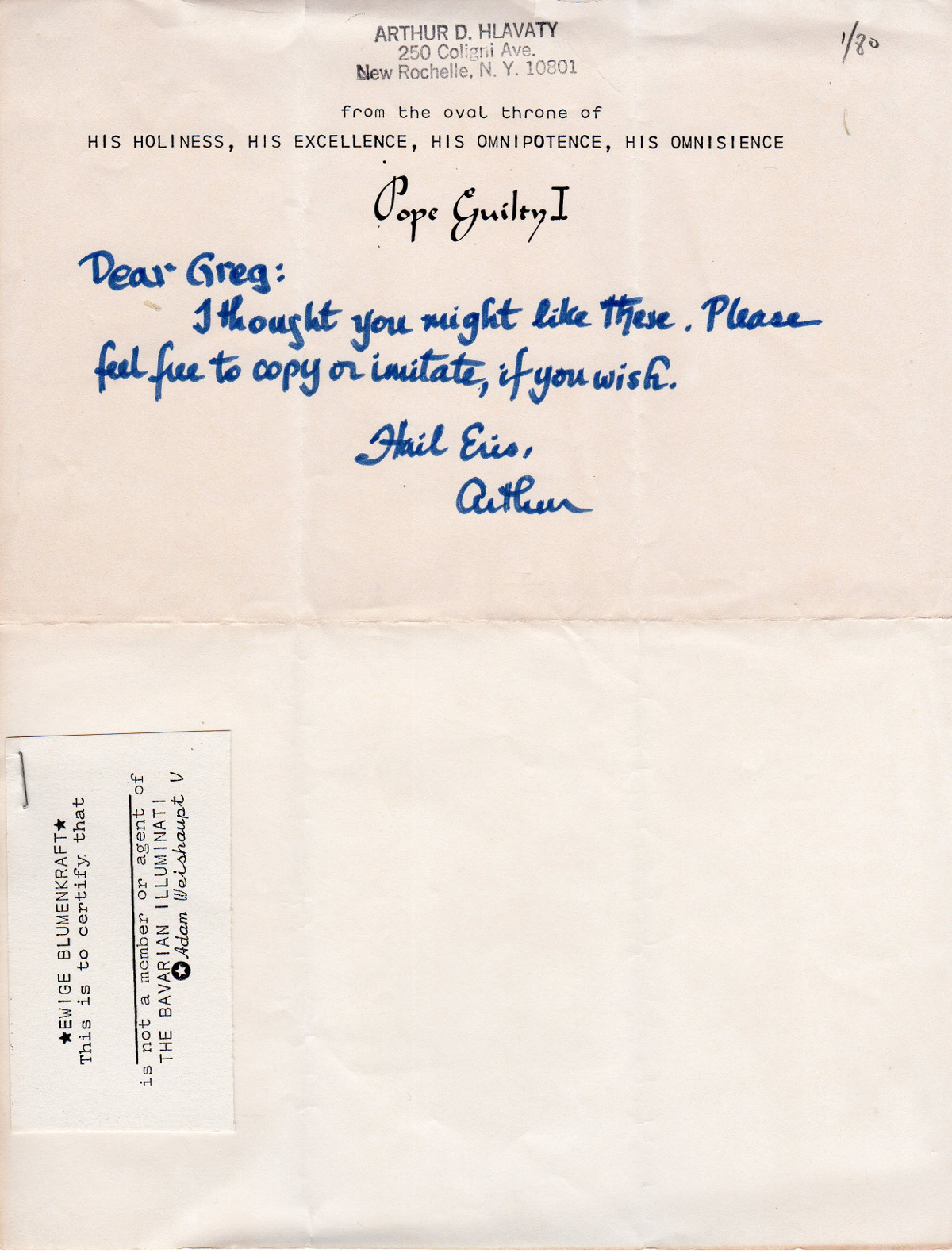
An anti-Bavarian Illuminati membership card sent to Greg Hill from Arthur Hlavaty (aka Pope Guilty I) circa January 1980.
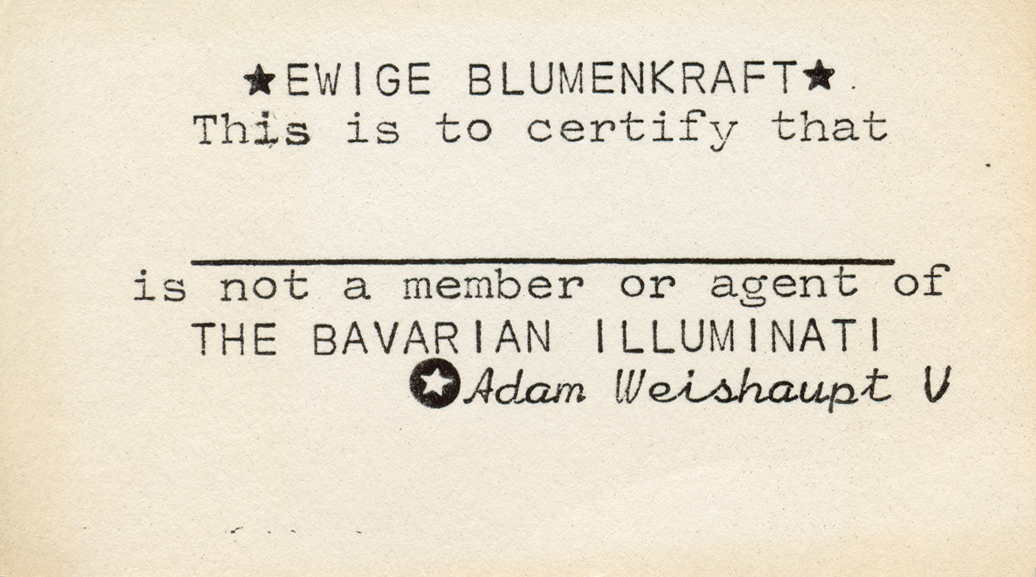
January 1980 Ewige Blumenkfraft card from Arthur Hlavaty to Greg Hill.Ewige Blumenkraft card.
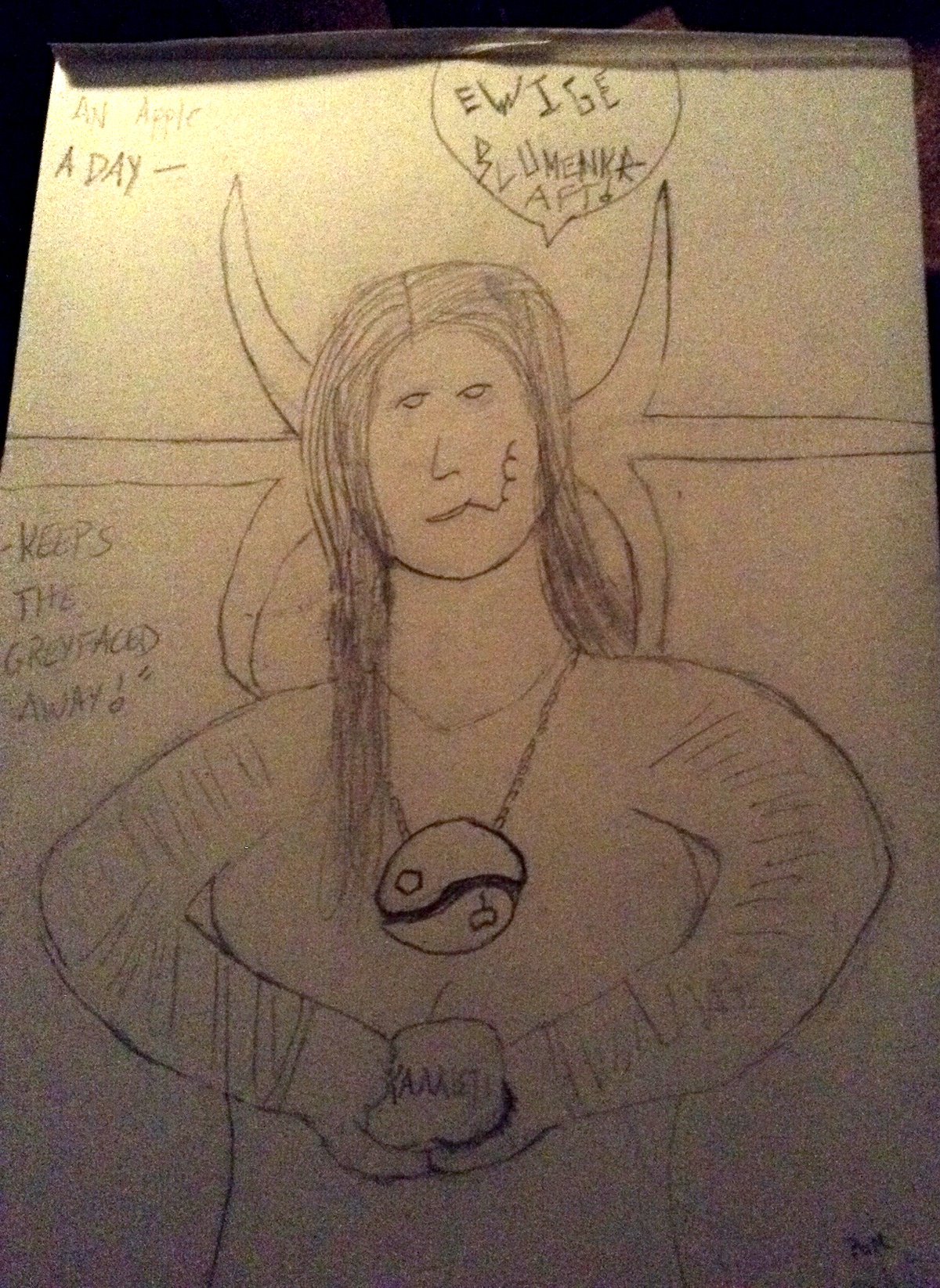
September 2015 Eris of the Month, 'An Apple A Day' by Pope Dan Ammon (the Twenty-) III
The fall (bababadalgharaghtakamminarronnkonnbronntonner-
ronntuonnthunntrovarrhounawnskawntoohoohoordenenthur-
nuk!) of a once wallstrait oldparr is retaled early in bed and later
on life down through all christian minstrelsy.
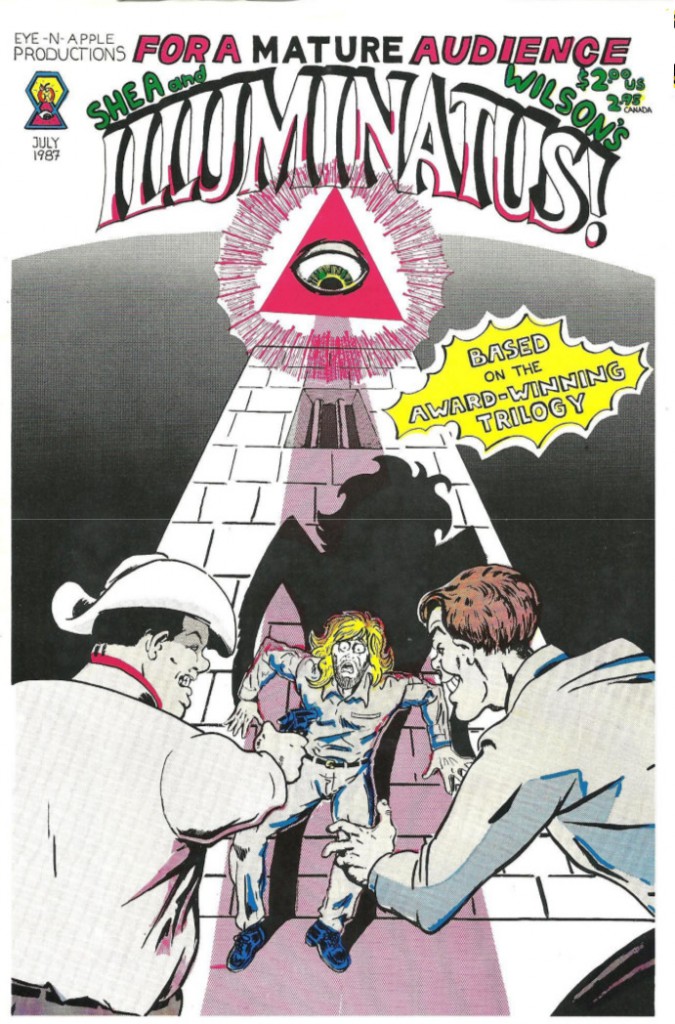
I recently received this announcement from Mark Philip Steele:
“Good news, folks, the ILLUMINATUS! comic I published back in 1987 is now in e-comic format, including text commentary. It’s a zip file available for download, and may end up at other sites in other formats. If you’re interested, download the comic and contact me about it. Some of the comments MAY be posted in further editions. There was one self-published issue, then 3 with Rip Off Press, and an unpublished 4th issue. Plans are for us to release one a month from now till we’re done.”
Christian GreerDespite numerous attempts to analyze its history, symbols, practices, and beliefs, scholarship on Discordianism has been largely deficient. The most pressing problem is that scholars have neglected the majority of Discordianism’s primary source materials, and are thus unable to provide the necessary contextual understanding for the readily available texts (and web-resources) they do study. The effect is that academic treatments of Discordianism have essentialized the religion according to a small, self-selected number of commercial publications entirely removed from their historical context.1
One of Discordianism’s two founders, Kerry Thornley, famously declared that if ‘religion is the opium of the masses, [then] Discordianism is the marijuana of the lunatic fringe,’ and this is made nowhere more clear than in its material culture over the last fifty-six years.2 The majority of Discordianism’s material culture has been comprised of self-published work in the form of religious certificates, ‘zines’, APAs (amateur press associations), live audio recordings of Robert Anton Wilson lectures, and, with the advent of the internet, BBSes (Bulletin Board System), PFDs, and blogs.3 The paper ephemera of Discordianism’s material history has not been catalogued by libraries, nor preserved by universities, but commonly remains in the possession of its initial recipients, or forgotten in the boxes that compose private zine archives. Lacking any familiarity with this ‘underground’ material, scholarly analysis of the mass-marketed Discordian texts, and Discordianism in toto, has been altogether superficial.
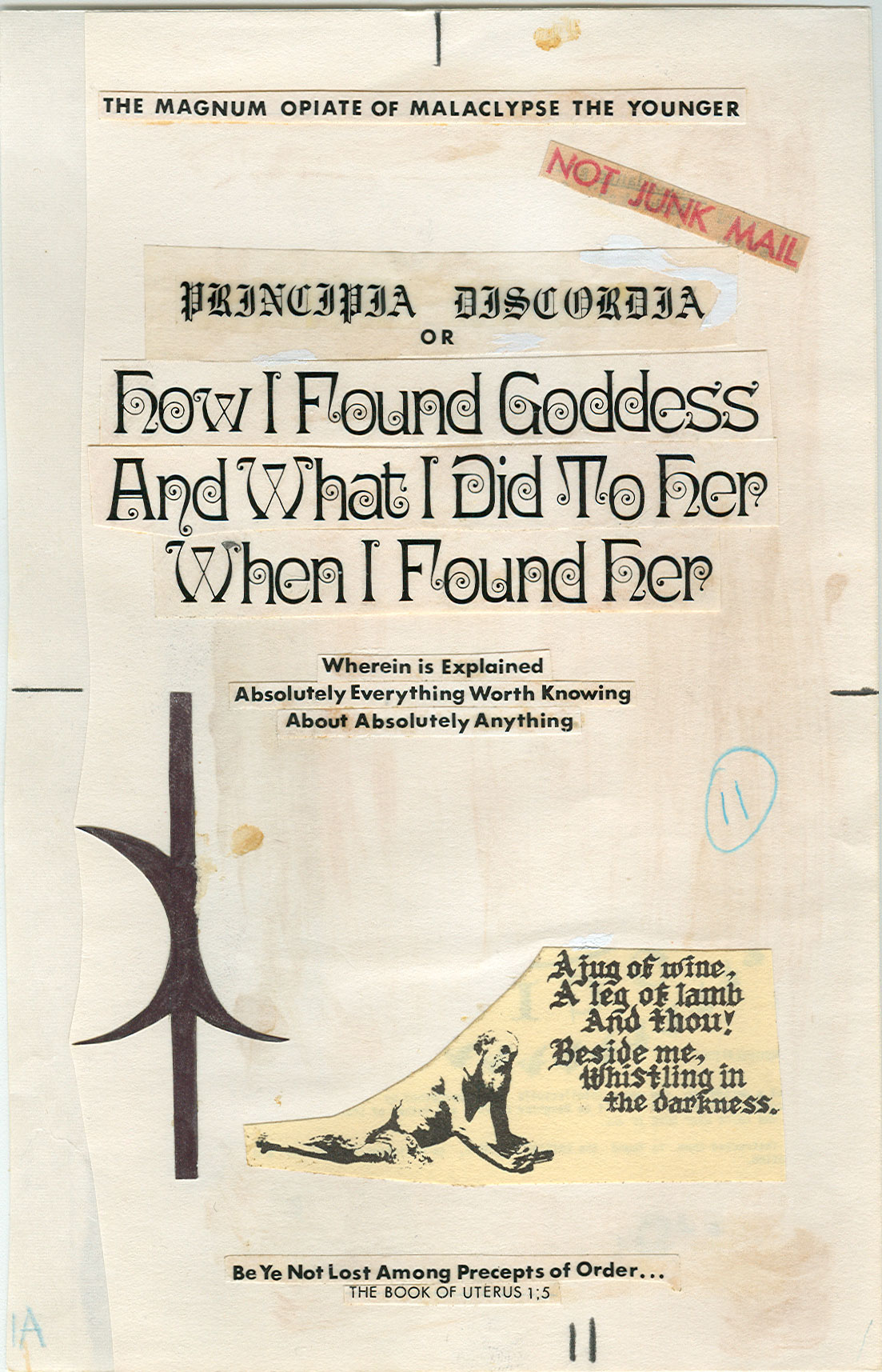
The front piece to the Paste-Up Discordia (The Sacred PUD). Courtesy the Discordian Archives.There are three major issues that have so far marred the study of Discordianism. The first concerns what has emerged as the locus classicus of Discordianism, the Princpia Discordia. As the first major Discordian text, the Principia Discordia went through four different versions before the publication of the Loompanics 4th/5th edition in 1979/1980, which most Discordians and scholars consider definitive.4 Deriving an interpretation of Discordianism from the Loompanics version of the 4th/5th edition, or any other edition of the Principia, effectively ignores the decades of doctrinal development that took place from its founding to the first printing of the 4th edition in 1970 by Rip Off Press. In neglecting the historical developments that led to the mass-marketed 4th/5th editions of the Principia, as well as the enormous amount of other self-produced Discordian materials dating from the late 1950s onwards, scholars have anachronistically defined Discordianism according to aspects of its present existence.5
The second issue concerns the lack of scholarly convention concerning which version of the Principia is regarded as authoritative. As a result of the 4th edition Principia’s ‘copyleft,’ or anti-copyright status, there are no less than five different published versions of the 4th/5th edition, in addition to innumerable online versions. While there is not a great deal of difference between versions, scholarly neglect of this point, as well as the lack of convention concerning which version of the 4th/5th edition of the Principia should be treated as authoritative, has instilled an unnecessary amount of irregularity into the study of Discordianism.6
The third issue is partly based on the first, but regards a more general misinterpretation of the meaning of the Principia within the Discordian milieu. Scholars regard the 4th/5th edition of the text as the central Discordian holy work, and it is not hard to understand why; it seems to offer all of the requisite data for a normative appraisal of a religious movement. It contains an origin story for the religion, a list of commandments, a liturgical calendar, a list of saints, and an account of Discordianism’s principle deity, Eris. In sum, the 4th/5th edition of the Principia seems to be a perfect index of everything a ‘real’ religion needs. This, of course, is precisely the problem. Leaving aside the fact that many of the aforementioned ‘religious’ aspects of Discordianism were added in successive editions of the Principia, the primary issue here is that Discordianism is explicitly not based on liturgical observance or orthopraxis, but rather on the utilization of beliefs as heuristic tools. Scholarly preoccupation with the religious minutia contained in the Principia evidences that scholars have missed an essential aspect of the Discordian ludibrium.
Since the various publications of the 4th and 4th/5th editions of the Principia read like conventional holy texts, or at least as a parody of one, scholars have mistakenly taken it as the text that has governed Discordianism since its inception. While some contemporary Discordians may revere it as such, familiarity with previous editions of the text, let alone the history of Discordianism, make it clear that this was not always the case. Discordianism did not reach underground audiences until nearly two decades after it was founded, and even then it was not an edition of the Principia that publicized the religion, but a trilogy of novels. Despite having numerous quotes from the Principia, the fictitious nature of Robert Anton Wilson and Robert Shea’s Illuminatus! trilogy (1975) of novels led many to believe that the Principia did not actually exist á la Lovecraft’s Necronomicon. Needless to say, Discordianism’s underground popularization was not based on teachings outlined in the first, second, third, or fourth editions of the Principia, but Wilson and Shea’s interpretation of them in Illuminatus! The first widely popular edition of the Principia was published nearly five years after Illuminatus! as a result of Loompanics publisher Mike Hoy reading the trilogy, and querying Hill himself as to the existence of such a text.7 The shift to institutionalization in contemporary Discordianism has led to the formalization of Discordian beliefs, and, central to this has been the reframing of the Principia as foundational to the religion. The scholarly preoccupation with the contents of the Principia illustrates the way in which scholars’ research agendas owe more to the contemporary trend towards institutionalization within the religion than rigorous historical research on it.
Read in terms of its evolution and alongside other Discordian material, it is evident that the various editions of the Principia were never merely parodies of sacred texts, nor were they strictly genuine attempts to fashion one. Instead, they were iterations of an idiosyncratic form of genre appropriation based on the conviction that all beliefs are heuristic tools for creating models of reality. Said more precisely, the various editions of the Principia were not just satire, but prime examples of the assiduous playing with religious forms that epitomizes Discordian belief. Essentially, this type of humorous play functions as the liturgical language of Discordianism. Reflecting William Burroughs’s famous adage, ‘nothing is true and everything is permitted,’ Discordianism is a meta-belief system in which abstract concepts like ‘holy scripture’ are utilized as expedient means to destabilize fixed assumptions about reality. Though more salient in later editions, the Principia appropriated the genre of sacred scripture in the same way that Camden Benares’ Discordian treatise, Zen Without Zen Masters (1977), utilizes tropes associated with Zen koan books, and the same is true for the appropriation of conspiracy theory in Wilson and Shea’s Illuminatus! trilogy. Discordian texts have taken the form of science fiction epics, historical dramas, anarchist philosophy, psychologized-occult manuals, and Zen teachings, and regardless of their form, the dynamics of these genre appropriations are the same. Discordian authors appropriate genre conventions only to exploit their ability to communicate the central metaphysical truth of their religion, namely, that the experience of reality entirely depends on the belief system, or model through which it is comprehended.8
Christian Greer is a PhD researcher in the field of Western esotericism at the University of Amsterdam. His primary focus is the history and material culture of Discordianism, the Church of the SubGenius and the Moorish Orthodox Church, particularly in the 1980-1990s. His dissertation, Angelheaded Hipsters: From Beatnik Antinomianism to Psychedelic Millenarianism is an intellectual history of the “counterculture” beginning with the revolutionary movements of the 1960s and ending in the 1990s with cyberpunk and fin de siècle cyberculture.
1 For a more detailed analysis of this problem in the work of one scholar, see Greer, Christian. ‘Review of Carole M. Cusack’s Invented Religions: Imagination, Fiction and Faith,’ Correspondences 2.1 (2014), pp. 109–114.
4 The Loompanics edition (1979) is known as the ‘4th/5th edition’ because it reprinted the original 4th edition published by Rip Off Press in 1970, as well as the 5th edition, which was nothing more than a Western Union telegram filled with the letter ‘M’. The Loompanics version is most likely considered authoritative on account of it being the first to include the 5th edition telegram, as well as material that was not included in previous editions, e.g. ‘the Gypsie Skrypto interview,’ and an introduction by Robert Anton Wilson. For a more comprehensive overview of the publishing history of the Principia Discordia see Gorightly, Adam. ‘Adam Gorightly on the Publishing History of the Principia Discordia’ https://www.youtube.com/watch?v=bUqVrH4luXc accessed 04/05/13; see also f.8.
5 Cusack’s Invented Religion (2010) exemplifies this error insofar as her familiarity with the Principia Discordia is limited to two mass marketed 4th/5th editions of the text, which bear little resemblance to the first edition produced decades earlier. This is made obvious by the fact that she seems unaware that the first edition had a different title as well as entirely different contents. See Cusack, Carole. Invented Religions: Imagination, Fiction and Faith, Farnham: Ashgate, 2010, p.28-29 as compared to the first edition reproduced in Gorightly, Adam. Historia Discordia: The Origins of the Discordian Society. New York: RVP Press, 2014, pp.25-80. Cusack is by no means the only scholar to make this mistake, indeed, the difference between editions of the Principia has not been noticed within any notable study of Discordianism; see also Urban, Hugh. Magia Sexualis: Sex, Magic, Liberation in Modern Western Esotericism. Berkeley: University of California Press, 2006, p. 233-235; Versluis, Arthur. American Gurus: From Transcendentalism to New Age Religion. New York: Oxford University Press, 2014, p.123-138.
6 The three most important academic texts on Discordianism have all used different versions of the 4th/5th edition of the Principia: Cusack cites the Steve Jackson Games version in Invented Religion (2010), Urban references the Loompanics version in Magia Sexualis (2006), and Versluis based his work in American Gurus (2014) on the Illuminet edition.
7 The earliest version of the popular Loompanics edition of the Principia was published in 1979, and it featured an introduction by Hoy. This version was superseded by the popular 1980 edition, which contained Wilson’s introduction. See Gorightly, ‘Adam Gorightly on the Publishing History of the Principia Discordia’.
8 Wilson refers to the means by which an individual can ‘meta-program’ their own reality as the ‘final secret of the Illuminati’. See Wilson, Robert A. Cosmic Trigger: Final Secret of the Illuminati Vol.1, Tempe, AZ.: New Falcon Publications, 1997, pp.29, 68-71.
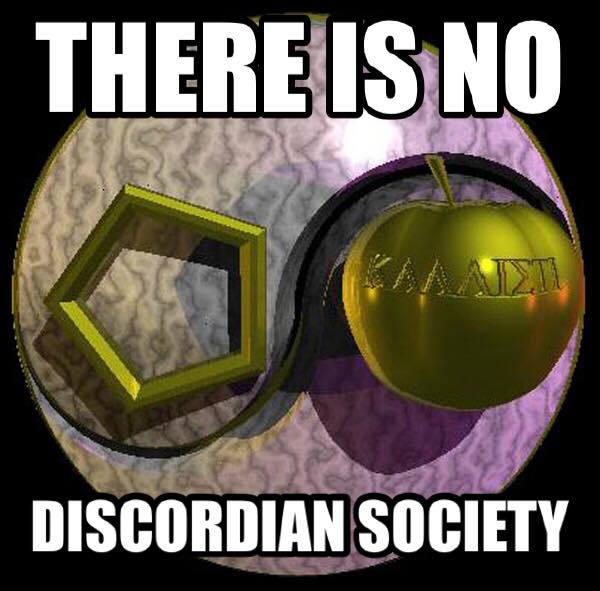 Inspired by last year’s production of Daisy Campbell’s Cosmic Trigger Play and Find the Others Festival, an intrepid group of Discordians across the pond are crowdsourcing a Disco free-for-all called Festival 23 slated for the weekend of July 23rd, 2016 that is described as “An interactive celebration of literature and the arts; of theatre, playshops and music inspired by the Discordian movement; a society of philosophers, theologians, magicians, scientists, artists, clowns and similar maniacs who are intrigued with Eris, Goddess of Confusion, and with her doings.”
 To coincide with all these Cosmic Trigger related happenings, the RAW estate has just announced the official launch of its publishing arm Hilartius Press and re-release of a whole slew of RAW titles. First out of the chutes will be—you guessed it!—Cosmic Trigger I: The Final Secret of the Illuminati with a brand spanking new intro by John Higgs author of the fabulous Discordian title KLF: Chaos Magic Music Money that if you haven’t read, you really should, and quickly.